Research Context
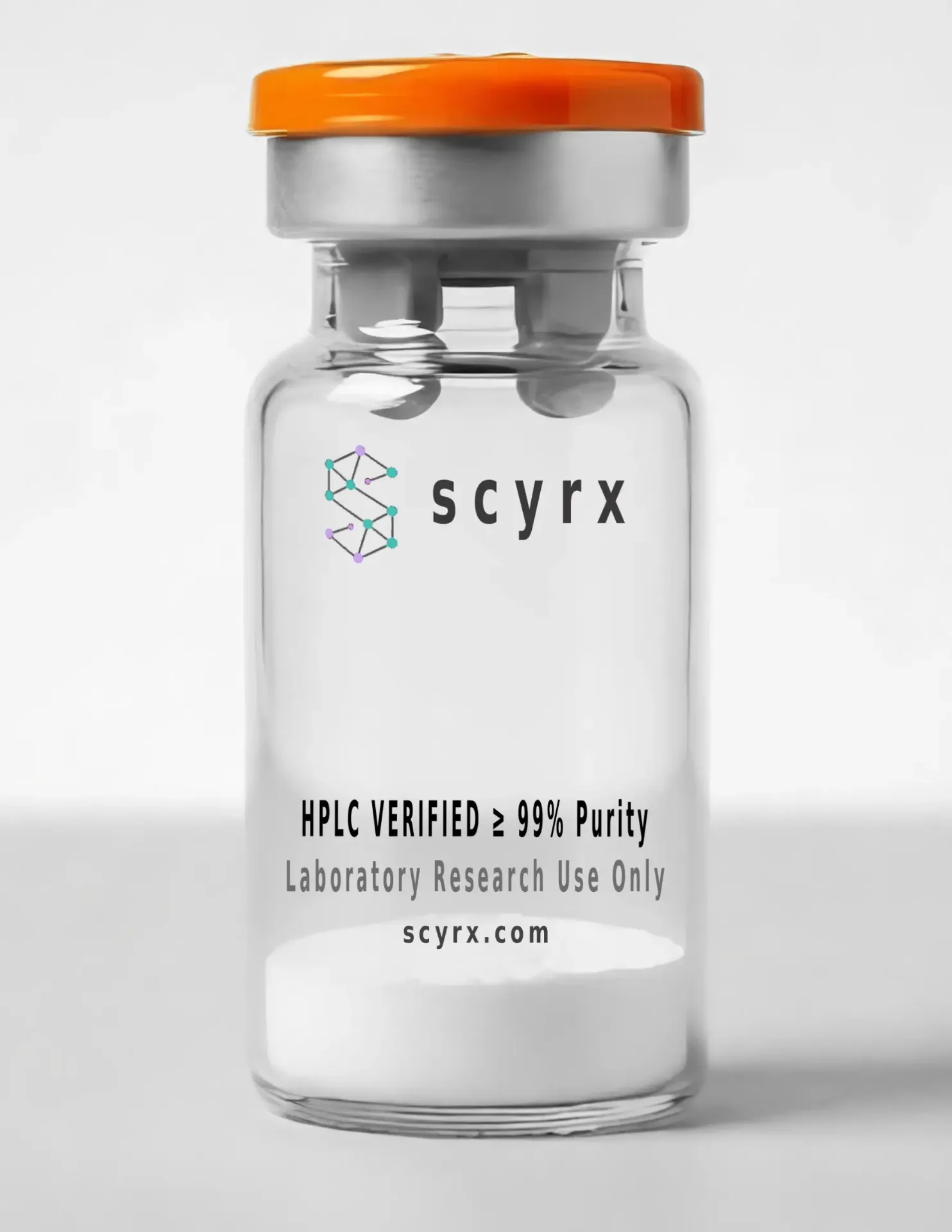
Our Thymosin Alpha-1 vial is a 28-amino-acid peptide naturally produced by the thymus, synthesized to >99% HPLC purity for T-cell and innate-immunity research. A frequently cataloged compound in immunomodulatory protocols, TA1 is studied for its mechanistic profile in controlled laboratory investigations alongside complementary research compounds for comparative and pathway-level studies.
Thymosin Alpha-1 (Thymalfasin): Bidirectional Immunomodulatory Research Peptide
Thymosin Alpha-1 — often referred to in research communities as TA1, T-alpha, or Tα1 — is a naturally occurring, 28-amino-acid peptide originally isolated from the thymus gland. TA1 is a highly potent, bidirectional immunomodulator, meaning it is studied for its ability to restore impaired immune function in immunosuppressed models while simultaneously helping to regulate and calm overactive immune responses in inflammatory models.
In pharmaceutical literature, the synthetic version of this peptide is known as Thymalfasin (formerly developed under the brand name Zadaxin). Because of its profound effects on T-cell maturation and Toll-like receptor (TLR) activation, TA1 is one of the most heavily researched peptides for viral pathogenesis, immune restoration, and host-defense protocols.
Unlike many other research compounds that are dosed in milligram quantities, Thymosin Alpha-1 is highly biologically active and is typically evaluated in research models at microgram (mcg) dosages. Laboratories looking to buy research-grade Thymosin Alpha-1 typically source mcg-dosed material with batch-specific HPLC verification.
SCYRX offers Thymosin Alpha-1 for sale exclusively to qualified researchers and institutions. Every lyophilized vial is supplied with a third-party Certificate of Analysis confirming ≥99% HPLC purity for in vitro investigation only.
Thymosin Alpha-1 Mechanism of Action: TLR Activation and T-Cell Modulation
The primary mechanism of Tα1 involves direct interaction with the innate immune system via Toll-like receptors, specifically TLR2, TLR4, and TLR9. By binding to these receptors on dendritic cells and macrophages, TA1 initiates a signaling cascade that bridges innate immunity with adaptive immunity, effectively "waking up" a suppressed immune response.
In the adaptive immune system, Thymosin Alpha-1 is studied for its ability to promote the maturation and function of T-cells. Research demonstrates that T-alpha increases the expression of Major Histocompatibility Complex (MHC) class I molecules on cell surfaces, enhances the activity of cytotoxic T-lymphocytes (CD8+ cells), and boosts the cytotoxicity of Natural Killer (NK) cells, which are critical for clearing virally infected or senescent cells.
TA1 promotes a balanced immune response by shifting the cytokine profile toward a protective Th1 phenotype. It increases the production of interleukin-2 (IL-2) and interferon-gamma (IFN-γ), which are vital for cellular immunity, while simultaneously suppressing excessive pro-inflammatory cytokines that drive tissue damage in autoimmune or hyper-inflammatory models.
Thymosin Alpha-1 vs. KPV vs. LL-37: Comparative Immune Research Analysis
Researchers frequently compare these three immune-modulating peptides to understand the trade-offs between systemic immune restoration, localized mucosal anti-inflammatory action, and innate antimicrobial defense.
| Feature | Thymosin Alpha-1 (TA1) | KPV | LL-37 |
|---|---|---|---|
| Peptide Length | 28 amino acids | 3 amino acids (Lys-Pro-Val) | 37 amino acids (Cathelicidin) |
| Primary Mechanism | Systemic immunomodulation via TLR2/4/9 activation | Localized mucosal anti-inflammatory via NF-κB inhibition | Innate antimicrobial and immunomodulatory via membrane disruption |
| Immune Focus | Adaptive immunity (T-cell maturation, NK cell activation) | Mucosal/Gut immunity (Intestinal barrier protection) | Innate immunity (Direct pathogen neutralization) |
| Cytokine Effect | Promotes Th1 response (IL-2, IFN-γ) | Suppresses pro-inflammatory cytokines (IL-1β, IL-6, TNF-α) | Modulates chemokine production and neutrophil recruitment |
| Primary Research Application | Viral pathogenesis, immune suppression, vaccine adjuvant | Inflammatory bowel disease (IBD), gut barrier dysfunction, colitis | Wound healing, antimicrobial resistance, biofilm disruption |
| Typical Research Dosing Scale | Micrograms (mcg) | Milligrams (mg) | Milligrams (mg) |
Note: While Thymosin Alpha-1 (TA1) provides broad, systemic immune restoration, researchers targeting specific mucosal or gut inflammation often compare it to KPV, which offers highly localized anti-inflammatory effects without systemic immune stimulation. Formulation ratios and purity metrics may vary by batch.
Thymosin Alpha-1 Chemical Specifications (Acetate Salt)
| Specification | Value |
|---|---|
| Synonyms | Thymalfasin, TA1, T-alpha, Tα1, Zadaxin |
| Peptide Sequence | Ac-Ser-Asp-Ala-Ala-Val-Asp-Thr-Ser-Ser-Glu-Ile-Thr-Thr-Lys-Asp-Leu-Lys-Glu-Lys-Lys-Glu-Val-Val-Glu-Glu-Ala-Glu-Asn-OH |
| Peptide Length | 28 amino acids |
| Key Structural Notes | 28-amino-acid synthetic peptide; acetate salt form for enhanced solubility and stability; naturally occurring thymic peptide hormone with immunomodulatory properties |
| Structural Modification Overview | Acetate Salt Form: Acetate counterion enhances water solubility and stability for research applications. Immunomodulatory Peptide: Naturally occurring 28-amino-acid peptide hormone produced by the thymus gland. TLR Activation: Binds to Toll-like receptors (TLR2, TLR4, TLR9) to activate innate and adaptive immune pathways. T-Cell Maturation: Promotes T-cell differentiation, maturation, and function via cytokine modulation (IL-2, IFN-γ). Systemic Immune Support: Studied for immune restoration, viral pathogenesis, and host-defense protocols. |
| Base Chain | 28-amino-acid linear synthetic peptide (acetate salt) |
| Molecular Formula | C₁₂₉H₂₁₅N₃₃O₅₅ · x(C₂H₄O₂) |
| Molecular Weight | ~3168.3 g/mol (varies slightly depending on the exact number of bound acetic acid molecules) |
| SMILES | CC[C@H](C)[C@@H](C(=O)N[C@@H]([C@@H](C)O)C(=O)N[C@@H]([C@@H](C)O)C(=O)N[C@@H](CCCCN)C(=O)N[C@@H](CC(=O)O)C(=O)N[C@@H](CC(C)C)C(=O)N[C@@H](CCCCN)C(=O)N[C@@H](CCC(=O)O)C(=O)N[C@@H](CCCCN)C(=O)N[C@@H](CCCCN)C(=O)N[C@@H](CCC(=O)O)C(=O)N[C@@H](C(C)C)C(=O)N[C@@H](C(C)C)C(=O)N[C@@H](CCC(=O)O)C(=O)N[C@@H](CCC(=O)O)C(=O)N[C@@H](C)C(=O)N[C@@H](CCC(=O)O)C(=O)N[C@@H](CC(=O)N)C(=O)O)NC(=O)[C@H](CCC(=O)O)NC(=O)[C@H](CO)NC(=O)[C@H](CO)NC(=O)[C@H]([C@@H](C)O)NC(=O)[C@H](CC(=O)O)NC(=O)[C@H](C(C)C)NC(=O)[C@H](C)NC(=O)[C@H](C)NC(=O)[C@H](CC(=O)O)NC(=O)[C@H](CO)NC(=O)C |
| SMILES Note | SMILES string may or may not include the acetate counterion. Full structural details are available via PubChem CID 16130571. |
| Purity | ≥99% by HPLC |
| Form | Lyophilized white powder (Acetate Salt) |
Note: Formulation ratios and purity metrics may vary by batch. Always refer to the batch-specific Certificate of Analysis (COA) included with your order for exact composition and laboratory-verified specifications.
Thymosin Alpha-1: Acetate Salt vs. Free Base Comparison for Researchers
For researchers reviewing the literature, Thymosin Alpha-1 is available as both a freebase and an acetate salt form. The acetate salt form is the standard research-grade version supplied by SCYRX, offering enhanced solubility and stability for laboratory applications. The freebase reference data is provided below for comparative literature review purposes only.
| Specification | Acetate Salt (SCYRX Supply) | Free Base (Reference Only) |
|---|---|---|
| Number of Amino Acids | 28 | 28 |
| Molecular Formula | C₁₂₉H₂₁₅N₃₃O₅₅ · x(C₂H₄O₂) | C₁₂₉H₂₁₅N₃₃O₅₅ |
| Molecular Weight | ~3168.3 g/mol | 3108.28 g/mol |
| CAS Number | 62304-98-7 | 62304-98-7 |
| PubChem CID | 16130571 | 16130571 |
| Form | Acetate Salt | Free Base |
Note: Molecular weights for acetate salt forms are approximate and may vary depending on the number of bound acetate molecules (x) in the salt complex. Values provided are based on the peptide core plus acetate counterions and should be used as a reference for research purposes only. Always refer to the batch-specific Certificate of Analysis (COA) for exact molecular weight verification.
Storage and Stability
Lyophilized Thymosin Alpha-1 should typically be stored at −20 °C in a tightly sealed container, protected from light and moisture. Under these conditions, Tα1 generally remains stable for up to 24 months from the manufacture date.
Thymosin Alpha-1 can typically be shipped at room temperature for short periods (up to two weeks) without significant degradation, making TA1 suitable for standard shipping methods.
Once reconstituted with bacteriostatic water, the solution should be refrigerated at 2–8 °C and typically used within 28 days. Researchers should avoid repeated freeze–thaw cycles and vigorous shaking to maintain peptide integrity.
Research Protocol Considerations
Research Dosing Considerations
In preclinical research models, Thymosin Alpha-1 is evaluated in microgram (mcg) quantities. Administration is most frequently via subcutaneous injection. Due to its role in T-cell differentiation, it is often studied in protocols examining immune response kinetics and viral clearance. Researchers typically use reconstitution volumes of 1–3 mL for precise measurement.
Reconstitution and Dosing. Thymosin Alpha-1 is typically reconstituted with bacteriostatic water. Because Tα1 is highly potent and typically evaluated in microgram (mcg) amounts in research models, researchers must use precise reconstitution volumes (e.g., 1 mL to 3 mL) and highly accurate measurement tools (such as insulin syringes) to ensure correct dosing. Clinical protocols utilizing Thymalfasin typically involve subcutaneous administration twice weekly.
Complementary Research. Investigators studying comprehensive immune protocols often research Thymosin Alpha-1 alongside other immune-modulating compounds. For systemic immune restoration, TA1 is frequently studied alongside Thymulin or Epithalon, while for targeted gut/mucosal inflammation, researchers often compare its effects to those of the KPV peptide. Comparative repair-focused studies frequently reference BPC-157 for tissue-level context.
Thymosin Alpha-1 Research FAQ
Is Thymosin Alpha-1 legal for research purposes?
Yes. Thymosin Alpha-1 sold by SCYRX is intended strictly for in vitro laboratory research and is not for human or veterinary use. All products are sold to licensed researchers and institutions for laboratory research purposes only.
What is the primary mechanism of Thymosin Alpha-1 in immune research?
Thymosin Alpha-1 is a naturally occurring thymic peptide that plays a critical role in the maturation and differentiation of T-cells. It enhances the activity of both helper and cytotoxic T-cells, making it a potent tool for studying immune system regulation and response to pathogens.
How does Thymosin Alpha-1 differ from Thymalin?
While both are thymic peptides, Thymosin Alpha-1 is a specific 28-amino acid sequence with well-defined immunomodulatory properties. Thymalin is a broader polypeptide fraction. Research often focuses on Thymosin Alpha-1 for its precise ability to upregulate specific cytokines like IL-2 and IFN-gamma.
Why is Thymosin Alpha-1 frequently studied in virology research?
Research indicates that Thymosin Alpha-1 can enhance the body's antiviral state by increasing the production of interferons and improving the cytotoxic activity of Natural Killer (NK) cells. This makes it a valuable compound for studying host defense mechanisms against various viral agents.
Does Thymosin Alpha-1 cause significant side effects in research models?
Thymosin Alpha-1 is generally considered very safe in research literature. Due to its endogenous nature, it rarely causes adverse reactions. The most commonly reported effects are mild injection site irritation. It does not typically cause the systemic inflammation associated with some other immune stimulants.
Can Thymosin Alpha-1 be stacked with other immune peptides?
Yes. Researchers often combine Thymosin Alpha-1 with antimicrobial peptides like LL-37 or healing peptides like BPC-157 to study comprehensive immune and tissue repair protocols. Each should be reconstituted and administered separately to ensure stability.
Scientific References and Citations
- Goldstein G. The discovery of thymosin alpha-1. Ann N Y Acad Sci. 2007;1112:1-12. doi:10.1196/annals.1462.001
- Garaci E, et al. Thymosin alpha-1 in cancer. Ann N Y Acad Sci. 2009;1194:82-90. doi:10.1111/j.1749-6632.2009.05130.x
- Romani L, et al. Thymosin alpha-1 and Toll-like receptors. Ann N Y Acad Sci. 2008;1143:22-31. doi:10.1196/annals.1443.004
- King K, et al. Thymosin alpha-1 activates Toll-like receptor 2. Ann N Y Acad Sci. 2003;1001:223-230.
- Fierabracci A. The immunomodulatory properties of thymosin alpha-1. Immunol Res. 2012;53(1-3):166-174. doi:10.1007/s12026-012-8320-4
- Zagari A, et al. Thymosin alpha-1: a potential therapeutic for immune restoration. Expert Opin Biol Ther. 2010;10(4):599-608. doi:10.1517/14712591003634566