Research Context
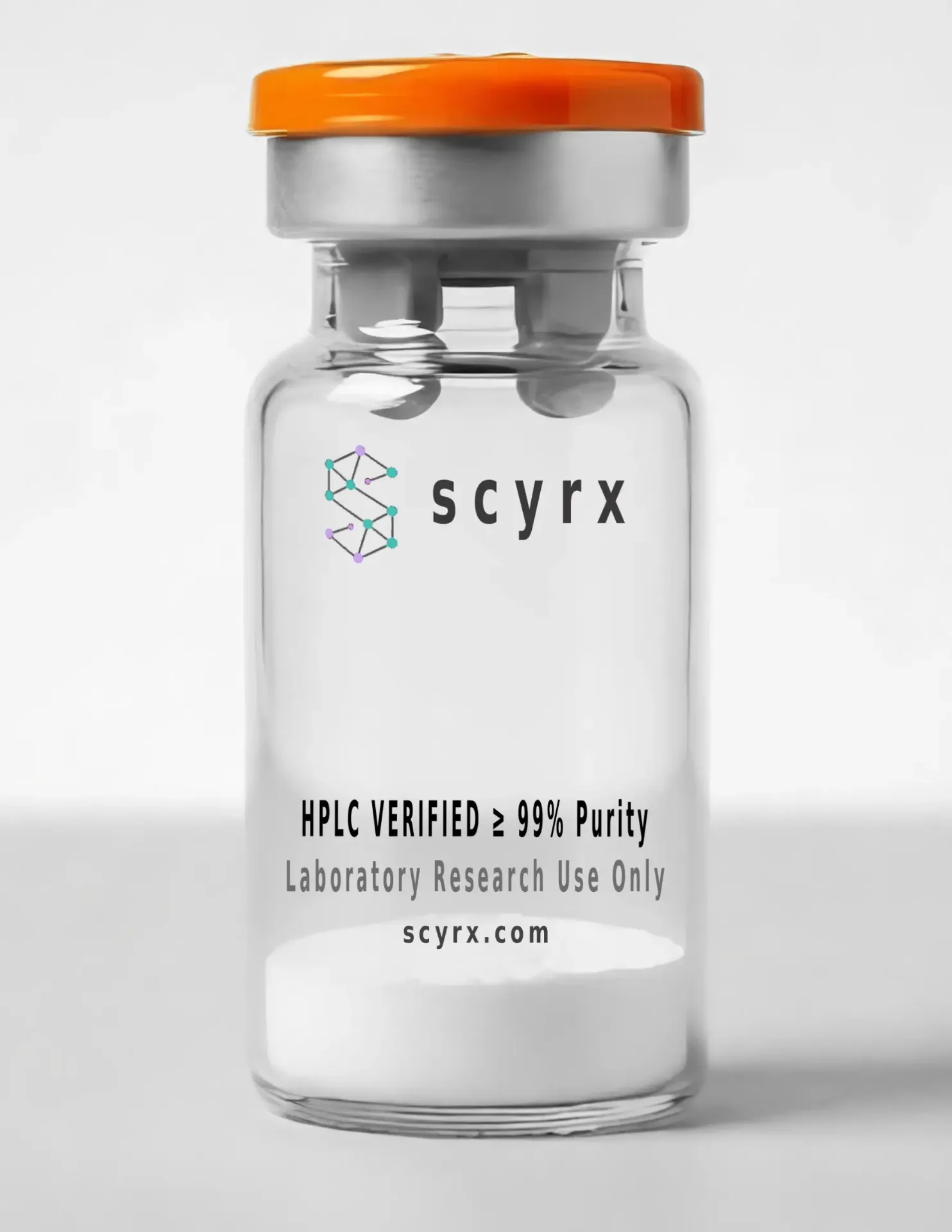
Our BPC-157 is a pentadecapeptide synthesized to >99% HPLC purity for tendon, ligament, and gut-barrier research models. Frequently referred to in laboratory shorthand as BPC, this 15-amino-acid compound is studied for connective-tissue repair, angiogenesis, and gastrointestinal mucosal healing in controlled laboratory investigations alongside complementary recovery compounds for comparative tissue-regeneration studies.
99% HPLC Purity · For Laboratory Research Use Only
Key Research Findings (At a Glance)
| Parameter | Summary |
|---|---|
| Peptide Structure | 15 amino acids (pentadecapeptide with C-terminal amide) |
| Origin | Derived from human gastric juice protein (Body Protection Compound) |
| Primary Mechanism | VEGF upregulation, nitric oxide modulation, angiogenesis |
| Key Research Areas | Tendon/ligament repair, gut barrier integrity, wound healing, cytoprotection |
| Distinguishing Feature | Accelerates healing of dense connective tissues with poor blood supply |
| Key Differentiator from TB-500 | Targets angiogenesis and gut mucosa; TB-500 targets cell migration and actin |
| Common Dosage Range (Preclinical) | 10–50 mcg per kg (subcutaneous or intraperitoneal) |
| Typical Administration | Subcutaneous injection (systemic) or local injection |
| Intended Use | Laboratory research only – not for human or veterinary consumption |
Overview
BPC-157 (Body Protection Compound-157) is a synthetic pentadecapeptide (15 amino acids) originally isolated and sequenced from human gastric juice. The peptide sequence (Gly-Glu-Pro-Pro-Pro-Gly-Lys-Pro-Ala-Asp-Asp-Ala-Gly-Leu-Val) is a fragment of a larger gastric protein that was identified for its remarkable cytoprotective properties.
Frequently referenced in research communities simply as BPC or BPC-157, this compound has become one of the most extensively studied peptides for connective tissue repair, angiogenesis, and gastrointestinal mucosal healing. Investigators who buy research-grade BPC-157 typically study its systemic efficacy when administered subcutaneously, unlike many growth factors that require direct injection into the injury site.
Research consistently shows it accelerates the healing of tendon, ligament, muscle, and bone injuries by promoting angiogenesis (new blood vessel formation) through upregulation of vascular endothelial growth factor (VEGF) and modulation of the nitric oxide (NO) pathway. When BPC-157 for sale is selected for comparative protocols, it serves as the primary angiogenesis benchmark alongside TB-500 in connective-tissue research.
BPC-157 is also heavily investigated for its gastroprotective effects in models of ulcers, inflammatory bowel disease, and gut barrier dysfunction. Its dual action on both connective tissue repair and mucosal healing makes BPC-157 a foundational compound in recovery and tissue regeneration research, often catalogued alongside GHK-Cu for dermal-versus-connective comparison studies.
BPC-157 is a 15-amino-acid linear peptide with a C-terminal amide that enhances its stability and resistance to enzymatic degradation. The free base form (CAS 137525-51-0) is often used in research protocols, while the acetate salt form (CAS 1628202-19-6) is commonly utilized for improved solubility and formulation stability. This balance of structural simplicity and pharmacological durability – combined with its systemic efficacy and angiogenic properties – has established BPC-157 as a foundational compound in connective tissue and gut barrier research.
Mechanism of Action: Angiogenesis and Cytoprotection
VEGF Upregulation and Angiogenesis
The primary mechanism of BPC-157 involves the upregulation of vascular endothelial growth factor (VEGF) expression in injured tissues. VEGF is a key signaling protein that stimulates the formation of new blood vessels (angiogenesis). By increasing VEGF, BPC-157 enhances blood supply to damaged areas, delivering oxygen and nutrients necessary for tissue repair. This is particularly critical for healing tendons and ligaments, which naturally have poor blood supply and slow recovery rates.
Nitric Oxide Pathway Modulation
BPC-157 modulates the nitric oxide (NO) signaling pathway, which plays a central role in vascular tone, inflammation regulation, and tissue perfusion. Research indicates BPC-157 helps maintain optimal NO levels at injury sites, promoting vasodilation and improved blood flow while simultaneously reducing excessive inflammatory responses. This balanced NO modulation contributes to its cytoprotective effects across multiple tissue types.
Gut Mucosal Protection and Healing
BPC-157 exhibits profound protective effects on the gastrointestinal mucosa. Studies demonstrate it accelerates the healing of gastric and intestinal ulcers, protects against mucosal damage from NSAIDs and alcohol, and helps restore gut barrier integrity in models of inflammatory bowel disease. The peptide appears to promote epithelial cell migration and proliferation, facilitating rapid mucosal repair while modulating inflammatory cytokine production.
Why Researchers Choose BPC-157 Over Other Recovery Peptides
Versus TB-500 (Thymosin Beta-4 Fragment): While both peptides promote tissue repair, they operate through different mechanisms. BPC-157 primarily drives angiogenesis and gut mucosal healing via VEGF/NO pathways. TB-500 primarily regulates actin cytoskeleton dynamics, promoting cell migration and reducing fibrosis. Researchers often choose BPC-157 when the focus is on vascularization and connective tissue repair, while TB-500 is preferred for soft tissue regeneration and anti-fibrotic effects.
Versus GHK-Cu (Copper Tripeptide): GHK-Cu primarily stimulates collagen synthesis and extracellular matrix remodeling through copper-dependent signaling. BPC-157 focuses more on angiogenesis and cytoprotection. Researchers select BPC-157 for tendon/ligament/gut applications, while GHK-Cu is preferred for dermal regeneration and skin remodeling studies.
Versus Traditional Growth Factors: Unlike many growth factors (such as PDGF or TGF-beta) that require local injection and have short half-lives, BPC-157 is stable, orally bioavailable in some studies, and effective systemically. This makes it a more practical research tool for studying widespread or multiple-site tissue repair.
Primary Research Applications
- Tendon and ligament injury repair modeling (Achilles, rotator cuff, ACL)
- Gut barrier integrity and inflammatory bowel disease (IBD) research
- Gastric ulcer healing and mucosal cytoprotection studies
- Angiogenesis and wound healing investigations
- Muscle tear and skeletal muscle regeneration models
- Bone fracture healing and osteogenesis research
- Neuroprotective effects and peripheral nerve injury studies
- Comparative connective tissue repair studies (vs. TB-500, GHK-Cu)
BPC-157 vs. TB-500 vs. GHK-Cu: Comparative Recovery and Healing Analysis
Researchers frequently compare these three peptides to understand distinct pathways through which they promote tissue repair, regeneration, and recovery.
| Feature | BPC-157 | TB-500 | GHK-Cu |
|---|---|---|---|
| Peptide Length | 15 amino acids | 43 amino acids (full Thymosin Beta-4) | 3 amino acids (copper-binding tripeptide) |
| Origin | Human gastric juice protein | Thymosin Beta-4 (endogenous) | Endogenous human plasma/urine/saliva |
| Primary Mechanism | VEGF upregulation, NO modulation, angiogenesis | Actin sequestration, cell migration, anti-fibrotic | Collagen synthesis, ECM remodeling, copper delivery |
| Primary Research Focus | Tendon/ligament repair, gut healing, angiogenesis | Soft tissue regeneration, cell migration, wound healing | Dermal regeneration, skin remodeling, anti-aging |
| Key Tissue Target | Connective tissue, gut mucosa, vasculature | Muscle, skin, cardiac tissue, CNS | Skin, dermis, hair follicles, connective tissue |
| Physiological Profile | Angiogenic, cytoprotective, gastroprotective | Pro-migratory, anti-fibrotic, anti-inflammatory | Remodeling, collagen-stimulating, antioxidant |
| Typical Research Dosing Scale | Micrograms (mcg) | Micrograms (mcg) | Micrograms to milligrams (mcg-mg) |
Note: While all three peptides promote tissue repair, BPC-157 is distinguished by its angiogenic and gastroprotective profile, making it the primary choice for tendon/ligament and gut research. TB-500 is preferred for cell migration and anti-fibrotic studies, while GHK-Cu is selected for dermal and collagen remodeling research. Formulation ratios and purity metrics may vary by batch.
Product Specifications
Chemical Specifications (Acetate Salt)
| Specification | Value |
|---|---|
| Synonyms | BPC-157, BPC 157, Body Protection Compound-157, Pentadecapeptide acetate |
| Peptide Sequence | Gly-Glu-Pro-Pro-Pro-Gly-Lys-Pro-Ala-Asp-Asp-Ala-Gly-Leu-Val |
| Peptide Length | 15 amino acids (Pentadecapeptide) |
| Key Structural Notes | 15-amino-acid synthetic pentadecapeptide; acetate salt form for enhanced solubility and stability |
| Structural Modification Overview | Acetate Salt Form: Prepared as acetate salt to enhance peptide solubility and stability for research use. C-terminal Amide: Free acid form with acetate counterion for improved formulation properties. Angiogenic Profile: Upregulates VEGF receptors and modulates nitric oxide signaling to promote angiogenesis. Cytoprotective: Supports tissue repair, tendon/ligament healing, and gastrointestinal mucosal protection. |
| Base Chain | 15-amino-acid linear synthetic pentadecapeptide (acetate salt) |
| Molecular Formula | C₆₂H₉₈N₁₆O₂₂ · xC₂H₄O₂ |
| Molecular Weight | ~1479.6 g/mol |
| SMILES | C[C@@H](C(=O)N[C@@H](CC(=O)O)C(=O)N[C@@H](CC(=O)O)C(=O)N[C@@H](C)C(=O)NCC(=O)N[C@@H](CC(C)C)C(=O)N[C@@H](C(C)C)C(=O)O)NC(=O)[C@@H]1CCCN1C(=O)[C@H](CCCCN)NC(=O)CNC(=O)[C@@H]2CCCN2C(=O)[C@@H]3CCCN3C(=O)[C@@H]4CCCN4C(=O)[C@H](CCC(=O)O)NC(=O)CN.CC(=O)O |
| SMILES Note | SMILES string may or may not include the acetate counterion. Full structural details are available via PubChem CID 155977614. |
| Purity | ≥99% by HPLC |
| Form | Lyophilized white powder (Acetate Salt) |
Note: Formulation ratios and purity metrics may vary by batch. Always refer to the batch-specific Certificate of Analysis (COA) included with your order for exact composition and laboratory-verified specifications.
BPC-157: Acetate Salt vs. Free Base Comparison for Researchers
For researchers reviewing the literature, BPC-157 is available as both a freebase and an acetate salt form. The acetate salt form is the standard research-grade version supplied by SCYRX, offering enhanced solubility and stability for laboratory applications. The freebase reference data is provided below for comparative literature review purposes only.
| Specification | Acetate Salt (SCYRX Supply) | Free Base (Reference Only) |
|---|---|---|
| Number of Amino Acids | 15 | 15 |
| Molecular Formula | C₆₄H₁₀₂N₁₆O₂₄ (C₆₂H₉₈N₁₆O₂₂ · C₂H₄O₂) | C₆₂H₉₈N₁₆O₂₂ |
| Molecular Weight | 1479.61 g/mol | 1419.56 g/mol |
| CAS Number | 216441-37-1 | 137525-51-0 |
| PubChem CID | 155977614 | 9941957 |
| Form | Acetate Salt | Free Base |
Note: Molecular weights for acetate salt forms are approximate and may vary depending on the number of bound acetate molecules (x) in the salt complex. Values provided are based on the peptide core plus acetate counterions and should be used as a reference for research purposes only. Always refer to the batch-specific Certificate of Analysis (COA) for exact molecular weight verification.
Storage and Stability
| Condition | Recommendation |
|---|---|
| Long-term storage (lyophilized) | −20°C in tightly sealed container, protected from light and moisture – stable for up to 24 months |
| Shipping | Room temperature (15–25°C) for short periods (up to two weeks) – no significant degradation |
| After reconstitution | Refrigerate at 2–8°C; use within 28 days |
| Handling precautions | Avoid repeated freeze-thaw cycles and vigorous shaking to maintain peptide integrity |
Research Protocol Considerations
Research Dosing Considerations
In preclinical research models, BPC-157 is evaluated in microgram (mcg) quantities, with common protocols ranging from 10–50 mcg per kg body weight. Administration is most frequently via subcutaneous injection for systemic effects, though local injection at injury sites is also utilized. Researchers typically use reconstitution volumes of 1–3 mL for precise measurement.
BPC-157 Research FAQ
Q: Is BPC-157 approved for human use in research quantities?
A: Research-grade BPC-157 is currently available for preclinical research only. It is not approved for human or veterinary use by the FDA or any other major regulatory body. It is supplied as a lyophilized powder for laboratory research purposes only. Researchers should consult all applicable institutional and regulatory guidelines before initiating study protocols.
Q: What is the primary mechanism of BPC-157 in tissue repair research?
A: BPC-157 primarily drives angiogenesis (new blood vessel formation) through upregulation of vascular endothelial growth factor (VEGF) and modulation of the nitric oxide (NO) pathway. This enhanced blood supply is critical for healing tendons and ligaments, which naturally have poor vascularization.
Q: Can BPC-157 be administered systemically or does it need local injection?
A: One of the unique properties of BPC-157 is its systemic efficacy. While some research protocols utilize local injection for targeted applications, studies consistently demonstrate that subcutaneous administration at distant sites produces significant healing effects at injury locations. This systemic activity is attributed to BPC-157's stability and its ability to modulate systemic angiogenic pathways.
Q: What is the difference between BPC-157 and TB-500?
A: BPC-157 is a 15-amino-acid gastric-derived peptide that primarily drives angiogenesis via VEGF upregulation and nitric oxide modulation. It is particularly effective for tendon, ligament, and gut mucosal healing. TB-500 is a 7-amino-acid active fragment of Thymosin Beta-4 that regulates actin dynamics, promoting cell migration and reducing fibrosis. BPC-157 is preferred when the research focus is vascularization and connective tissue repair.
Q: Is BPC-157 effective for gut health research?
A: Yes, BPC-157 was originally identified for its gastroprotective properties and remains one of the most extensively studied peptides for gut mucosal healing. Research demonstrates it accelerates the healing of gastric and intestinal ulcers, protects against mucosal damage, and helps restore gut barrier integrity in models of inflammatory bowel disease.
Q: Can BPC-157 be stacked with TB-500 in research protocols?
A: Yes, researchers frequently combine BPC-157 and TB-500 in preclinical models to study synergistic tissue repair effects. BPC-157 promotes angiogenesis (improving blood supply) while TB-500 promotes cell migration and reduces fibrosis. Researchers typically reconstitute each peptide separately and administer them as distinct interventions to avoid chemical interactions.
Scientific References and Citations
- Sikiric P, Seiwerth S, Rucman R, et al. The relationship between the cytoprotective action of BPC 157 and nitric oxide. J Physiol Paris. 2007;100(5-6):292-299. doi:10.1016/j.jphysparis.2007.03.003
- Seiwerth S, Rucman R, Vukojevic V, et al. BPC 157 and blood vessels: a review of experimental evidence. Drug Dev Ind Pharm. 2018;44(11):1763-1770. doi:10.1080/03639045.2018.1497734
- Chang CH, Kuo TF, Lin WC, et al. BPC 157 accelerates the healing of transected rat Achilles tendon. J Orthop Res. 2010;28(12):1620-1627. doi:10.1002/jor.21192
- Staresinic M, Pecina M, Lipovsek B, et al. Effect of growth hormone-releasing peptide (BPC 157) on muscle healing after surgical repair of the Achilles tendon in rats. J Surg Res. 2011;171(2):848-854. doi:10.1016/j.jss.2010.07.032
- Sikiric P, Seiwerth S, Grabarevic Z, et al. The influence of a novel pentadecapeptide BPC 157 on nitric oxide pathways in rats. Eur J Pharmacol. 2003;476(3):193-202. doi:10.1016/j.ejphar.2003.08.021
- Drmic D, Bilic Z, Sever M, et al. Stable gastric pentadecapeptide BPC 157 in the treatment of colitis in rats. World J Gastroenterol. 2015;21(40):11431-11442. doi:10.3748/wjg.v21.i40.11431