
Research Context
The KLOW STACK is a highly sought-after combination of research compounds — KPV, GHK-Cu, BPC, and TB — engineered for repair, regeneration, and inflammatory-modulation research models. Each component is supplied at >99% HPLC purity.
The KLOW STACK is one of the most-cited multi-peptide research stacks alongside the GLOW STACK and WOLVERINE STACK. These research peptides are foundational compounds in tissue-repair and immune-modulation studies.
A multi-peptide stack pairing KPV, GHK-Cu, BPC-157, and TB-500.
KLOW STACK: GHK-Cu/BPC-157/TB-500/KPV Quad-Peptide Research Complex
The KLOW STACK is a proprietary quad-peptide research formulation combining GHK-Cu (Copper Tripeptide-1), BPC-157 (Body Protection Compound-157), TB-500 (Thymosin Beta-4), and KPV (Lysine-Proline-Valine). This KLOW blend is specifically engineered for research models investigating comprehensive tissue regeneration, mucosal protection, extracellular matrix remodeling, and inflammatory modulation. The KLOW STACK is widely studied alongside the GLOW STACK (which contains three peptides without KPV) and the WOLVERINE STACK (which contains two peptides focused on connective tissue).
KPV serves as the distinguishing component of the KLOW STACK compared to the GLOW STACK. KPV is a tripeptide derived from the C-terminal sequence of alpha-melanocyte stimulating hormone (α-MSH) that provides potent anti-inflammatory effects through NF-κB pathway inhibition.
This quad-peptide synergy creates a comprehensive approach to tissue repair with simultaneous modulation of regenerative, angiogenic, matrix-remodeling, and inflammatory pathways. Investigators looking to buy research-grade KLOW Stack typically source mg-dosed material with batch-specific HPLC purity and Certificate of Analysis documentation.
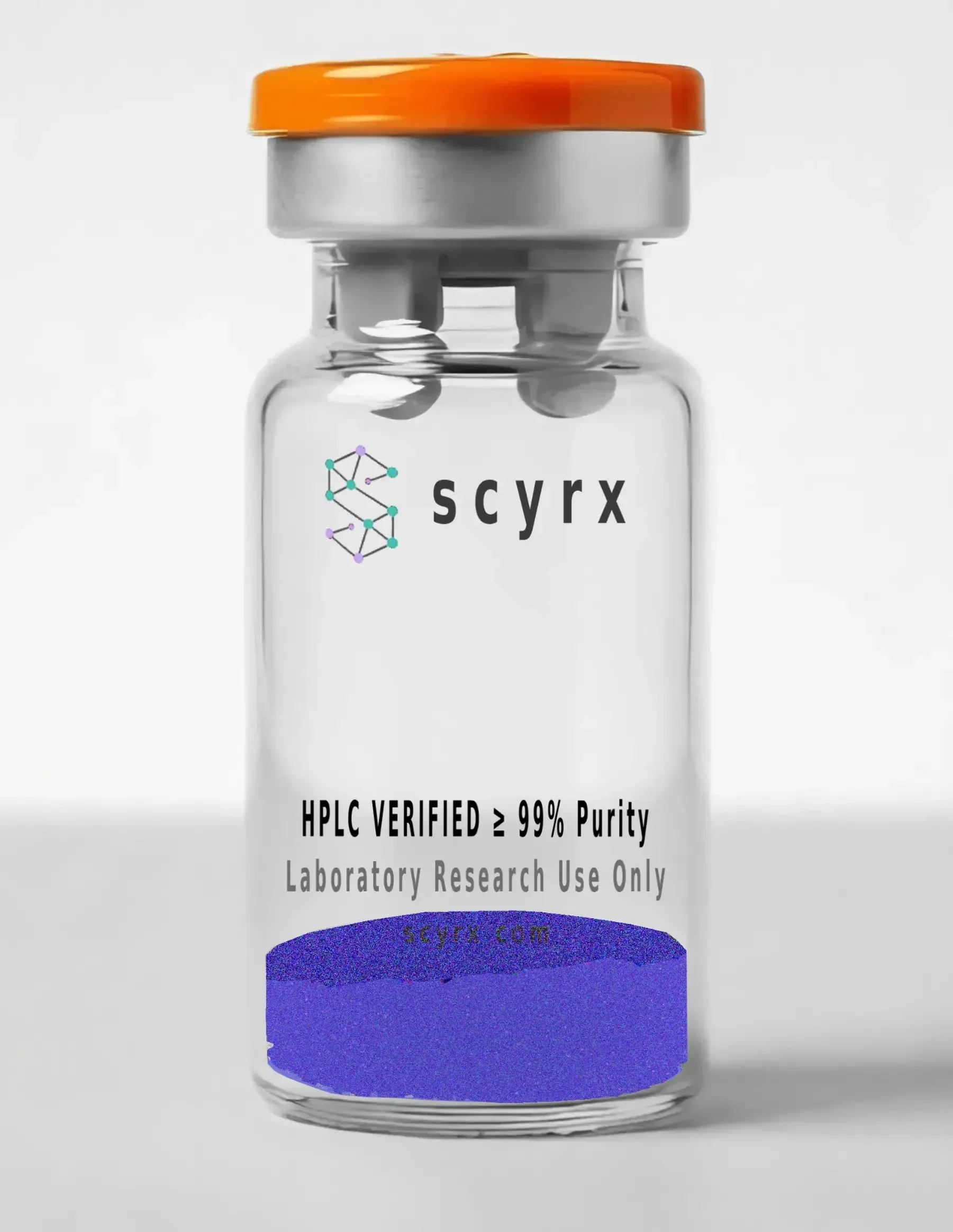
All components of the KLOW blend are supplied at ≥99% HPLC purity with batch-matched third-party Certificates of Analysis. SCYRX offers the KLOW Stack for sale exclusively to qualified researchers and institutions, intended for laboratory research purposes only and not approved for human use.
Individual Component Research Mechanisms
GHK-Cu (Glycyl-L-Histidyl-L-Lysine Copper Complex) is a naturally occurring tripeptide that functions as a copper delivery system and signaling molecule. Research demonstrates its ability to activate matrix metalloproteinases (MMP-2 and MMP-9) for extracellular matrix remodeling, upregulate collagen I and III synthesis in dermal fibroblasts, stimulate elastin production, and promote glycosaminoglycan synthesis. GHK-Cu also exhibits antioxidant activity through copper-dependent superoxide dismutase (SOD) activation and modulates gene expression related to tissue repair and anti-aging pathways.
BPC-157 is a 15-amino-acid peptide derived from human gastric juice. Research highlights its role in tissue repair through VEGF (Vascular Endothelial Growth Factor) receptor upregulation, nitric oxide pathway modulation, and enhanced angiogenesis. In the context of the KLOW STACK, BPC-157 contributes to dermal wound healing, mucosal protection, and connective tissue repair through mechanisms that complement GHK-Cu's collagen-stimulating effects.
TB-500 is the synthetic version of the 43-amino-acid peptide Thymosin Beta-4. Research focuses on its role in regulating actin cytoskeleton dynamics through G-actin sequestration, promoting cell migration to injury sites, stimulating angiogenesis, and reducing fibrosis and scar tissue formation. In the KLOW STACK, TB-500 enhances the regenerative environment by improving cellular recruitment and blood vessel formation, working synergistically with GHK-Cu's matrix remodeling effects.
KPV (Lysine-Proline-Valine) is a tripeptide derived from the C-terminal sequence of alpha-melanocyte stimulating hormone (α-MSH), specifically residues 188–190 of the α-MSH molecule. Research demonstrates KPV's potent anti-inflammatory effects through inhibition of the NF-κB (nuclear factor kappa-light-chain-enhancer of activated B cells) signaling pathway, which is a master regulator of inflammatory gene expression. KPV has been shown to reduce the production of pro-inflammatory cytokines including IL-1β, IL-6, and TNF-α, and exhibits particular efficacy in intestinal and dermal inflammatory models. In the KLOW STACK, KPV provides mucosal protection and inflammatory modulation that complements the regenerative effects of the other three peptides.
KLOW STACK Research Applications
Comprehensive Tissue Regeneration Research
The KLOW STACK is frequently selected for research models investigating multi-pathway tissue repair. The combination of GHK-Cu's collagen and elastin synthesis, BPC-157's angiogenic and mucosal healing properties, TB-500's cell migration and anti-fibrotic effects, and KPV's anti-inflammatory modulation creates a comprehensive approach to tissue regeneration. Studies investigate its effects on wound healing, surgical recovery, and multi-system tissue repair protocols.
Mucosal Protection and Intestinal Research
The addition of KPV distinguishes the KLOW STACK for research models focusing on mucosal integrity and intestinal inflammation. KPV has been extensively studied in models of inflammatory bowel disease (IBD), colitis, and intestinal barrier dysfunction. Research demonstrates KPV's ability to reduce intestinal inflammation, protect mucosal integrity, and modulate gut immune responses, making the KLOW blend particularly valuable for gastrointestinal research.
Inflammatory Modulation Research
The KLOW STACK is investigated for its comprehensive anti-inflammatory effects through multiple mechanisms. While GHK-Cu provides antioxidant activity, KPV directly inhibits NF-κB signaling, and TB-500 reduces fibrotic inflammatory responses. This multi-pathway anti-inflammatory approach is of interest in research on chronic inflammation, autoimmune models, and inflammatory tissue damage.
Dermal Regeneration and Anti-Aging Research
The KLOW STACK retains the dermal regenerative properties of the GLOW STACK through GHK-Cu's stimulation of collagen and elastin synthesis. The addition of KPV provides anti-inflammatory support that may enhance skin repair in inflammatory dermatological conditions. Research investigates its effects on skin aging, photoaging, wound healing, and inflammatory skin disorders.
KLOW STACK vs. GLOW STACK vs. WOLVERINE STACK: Comparative Analysis
| Feature | KLOW STACK | GLOW STACK | WOLVERINE STACK |
|---|---|---|---|
| Peptide Composition | GHK-Cu (50mg), BPC-157 (10mg), TB-500 (10mg), KPV (10mg) | GHK-Cu (50mg), BPC-157 (10mg), TB-500 (10mg) | BPC-157, TB-500 (1:1 ratio) |
| Total Peptide Content | 80mg | 70mg | 10mg or 20mg (varies by vial size) |
| Primary Research Focus | Comprehensive tissue regeneration with mucosal and anti-inflammatory support | Dermal regeneration, ECM remodeling, collagen synthesis | Connective tissue repair, musculoskeletal healing |
| Key Distinguishing Component | KPV (anti-inflammatory tripeptide from α-MSH) | GHK-Cu (copper peptide for collagen/elastin) | Standard-dose BPC-157 and TB-500 in 1:1 ratio (no GHK-Cu or KPV) |
| Angiogenesis Support | Yes (BPC-157, TB-500) | Yes (BPC-157, TB-500) | Yes (BPC-157, TB-500) |
| Collagen Synthesis | Yes (GHK-Cu) | Yes (GHK-Cu) | No (no GHK-Cu) |
| Anti-Inflammatory Pathway | Strong (KPV NF-κB inhibition plus GHK-Cu antioxidant) | Mild (GHK-Cu antioxidant only) | Minimal |
| Mucosal Protection | Strong (KPV plus BPC-157) | Mild (BPC-157 only) | Moderate (BPC-157) |
| Anti-Fibrotic Effects | Yes (TB-500, KPV) | Yes (TB-500) | Yes (TB-500) |
| Intestinal/Gut Research | Yes (KPV-specific) | Limited | Limited |
Note: WOLVERINE STACK is available in 10mg vials (5mg BPC-157 + 5mg TB-500) or 20mg vials (10mg BPC-157 + 10mg TB-500). Formulation ratios and total peptide content may vary by batch. Always refer to the batch-specific Certificate of Analysis (COA) included with your order for exact composition.
KLOW STACK Chemical Specifications (Acetate Salt)
| Specification | Value |
|---|---|
| Peptide Components | GHK-Cu, BPC-157, TB-500, KPV |
| GHK-Cu CAS Number | 49557-75-7 |
| GHK-Cu Molecular Formula | C₁₄H₂₄CuN₆O₄ |
| BPC-157 CAS Number | 137525-51-0 |
| BPC-157 Molecular Formula | C₆₂H₉₈N₁₆O₁₁ |
| TB-500 CAS Number | 77095-66-2 |
| TB-500 Molecular Formula | C₂₁₂H₃₅₀N₅₆O₇₈S |
| KPV Sequence | Lysine-Proline-Valine |
| KPV Molecular Formula | C₁₆H₃₀N₄O₄ |
| KPV Molar Mass | 342.43 g/mol |
| Typical Total Content | 80mg (may vary by batch) |
| Purity | ≥99% by HPLC |
| Form | Lyophilized white powder |
Note: Formulation ratios and purity metrics may vary by batch. Always refer to the batch-specific Certificate of Analysis (COA) included with your order for exact composition and laboratory-verified specifications.
Storage and Stability
Lyophilized KLOW STACK should typically be stored at −20 °C in a tightly sealed container, protected from light and moisture. Under these conditions, it generally remains stable for up to 24 months from the manufacture date.
The lyophilized KLOW blend can typically be shipped at room temperature for short periods (up to two weeks) without significant degradation, though refrigerated shipping is preferred for long-distance transport.
Once reconstituted with bacteriostatic water, the solution should be refrigerated at 2–8 °C and typically used within 28 days. Researchers should avoid repeated freeze-thaw cycles and vigorous shaking to maintain peptide integrity. GHK-Cu may impart a slight blue-green color to the reconstituted solution due to the copper complex, which is normal.
Research Protocol Considerations
Reconstitution. The KLOW STACK is typically reconstituted with bacteriostatic water. Typical reconstitution volumes range from 1–3 mL depending on desired concentration. Because the stack contains multiple peptides with different molecular weights, researchers should be aware that the final concentration of each individual peptide will vary based on its proportion in the blend.
Complementary Research. Investigators studying comprehensive regenerative or anti-inflammatory protocols often research the KLOW STACK alongside metabolic compounds like Semaglutide and RETA20, hormonal peptides like CJC-1295 and Ipamorelin, or other regenerative compounds. Researchers focusing primarily on dermal regeneration without mucosal/anti-inflammatory needs may compare the KLOW STACK to the GLOW STACK, which contains three peptides without KPV.
Research Dosing Considerations
In preclinical research models, KLOW is evaluated in milligram (mg) quantities due to its multi-peptide composition. Administration is most frequently via subcutaneous injection or oral delivery depending on the specific research protocol. Researchers typically use reconstitution volumes of 1–3 mL for precise measurement of the lyophilized blend.
Related Research Peptides
KLOW STACK Research FAQ
Is the KLOW Stack legal for research purposes?
Yes. The KLOW Stack sold by SCYRX is intended strictly for in vitro laboratory research and is not for human or veterinary use. All products are sold to licensed researchers and institutions for laboratory research purposes only.
Can the components of KLOW STACK be separated after reconstitution?
No. Once the lyophilized blend is reconstituted, the peptides are in solution together and cannot be physically separated for individual dosing. Researchers requiring individual peptide dosing should purchase separate vials of GHK-Cu, BPC-157, TB-500, and KPV.
How does KLOW STACK differ from GLOW STACK?
The KLOW STACK contains four peptides (GHK-Cu, BPC-157, TB-500, KPV) while the GLOW STACK contains three peptides (GHK-Cu, BPC-157, TB-500). The addition of KPV in the KLOW STACK provides potent anti-inflammatory effects through NF-κB pathway inhibition and enhanced mucosal protection, particularly in intestinal and gut research models. Researchers select KLOW when comprehensive tissue regeneration with anti-inflammatory and mucosal support is the primary focus.
Why does the reconstituted solution have a blue-green color?
The blue-green coloration is due to the presence of GHK-Cu (Copper Tripeptide-1), which naturally exhibits this color due to the copper complex. This is normal and indicates the presence of the copper peptide component.
What research models commonly utilize KLOW STACK?
The KLOW STACK is frequently selected for in vitro and in vivo studies investigating comprehensive tissue regeneration, intestinal inflammation and mucosal protection, inflammatory bowel disease models, surgical wound healing, multi-system tissue repair, and protocols requiring simultaneous modulation of regenerative, angiogenic, matrix-remodeling, and inflammatory pathways.
Can KLOW STACK be mixed with other peptides?
It is generally recommended to reconstitute and evaluate the KLOW STACK as a standalone formulation. Mixing it with other research peptides in the same vial prior to administration can lead to unpredictable chemical interactions or degradation. Researchers typically evaluate it separately or administer other compounds at different times.
Scientific References and Citations
- Pickart L, Margolina A. Regenerative and protective actions of the GHK-Cu peptide in the light of the new gene data. Int J Mol Sci. 2018;19(7):1968. doi:10.3390/ijms19071968
- Pickart L, Margolina A. GHK peptide as a natural modulator of multiple cellular pathways. BioMed Res Int. 2015;2015:648108. doi:10.1155/2015/648108
- Sidossis L, et al. The copper peptide GHK-Cu as a potential therapeutic for aging-related diseases. Front Endocrinol. 2023;14:1177667. doi:10.3389/fendo.2023.1177667
- Sikiric P, et al. The relationship between the cytoprotective action of BPC 157 and nitric oxide. J Physiol Paris. 2007;100(5-6):292-299. doi:10.1016/j.jphysparis.2007.03.003
- Seiwerth S, et al. BPC 157 and blood vessels: a review of experimental evidence. Drug Dev Ind Pharm. 2018;44(11):1763-1770. doi:10.1080/03639045.2018.1497734
- Goldstein AM, et al. Thymosin beta 4 promotes cardiac myocyte survival and reduces infarct size after ischemia-reperfusion injury. Ann N Y Acad Sci. 2012;1269:155-163. doi:10.1111/j.1749-6632.2012.06705.x
- Malinda KM, et al. Thymosin beta 4 and its fragment KTTKS stimulate matrix metalloproteinase expression in human dermal fibroblasts. Ann N Y Acad Sci. 1999;885:422-424. doi:10.1111/j.1749-6632.1999.tb09785.x
- Lee JD, et al. Thymosin beta 4 enhances wound healing through promotion of angiogenesis and cell migration. Wound Repair Regen. 2014;22(3):389-398. doi:10.1111/wrr.12169
- Brzoska T, Luger TA, Bohm M. The melanocortin system and its regulation. Endocr Rev. 2005;26(7):925-951. doi:10.1210/er.2005-0006
- Catania A, et al. The melanocortin system in inflammation. Ann N Y Acad Sci. 2005;1057:365-373. doi:10.1196/annals.1356.026
- Kwon HK, et al. Anti-inflammatory effects of KPV peptide in intestinal epithelial cells. Peptides. 2012;38(2):452-458. doi:10.1016/j.peptides.2012.09.020
- Chen W, et al. KPV peptide inhibits NF-κB activation and reduces intestinal inflammation. Inflamm Bowel Dis. 2014;20(8):1385-1394. doi:10.1097/MIB.0000000000000115
- Rajor MA, et al. Alpha-melanocyte stimulating hormone and its derivatives in inflammatory regulation. J Invest Dermatol. 2018;138(5):1018-1026. doi:10.1016/j.jid.2017.11.028
- Webber CA, et al. Thymosin beta 4 improves functional recovery after spinal cord injury. Ann N Y Acad Sci. 2012;1269:164-171. doi:10.1111/j.1749-6632.2012.06706.x
- Pollard JD, et al. Thymosin beta 4 promotes axonal growth and remyelination in the central nervous system. FASEB J. 2006;20(9):1537-1539. doi:10.1096/fj.05-5417fje