Research Context
Our GHK-Cu is a naturally occurring copper-binding tripeptide (Gly-His-Lys) synthesized to >99% HPLC purity for dermal, fibroblast, and extracellular-matrix research models. Frequently referred to in laboratory shorthand as GHK-Cu or Copper Peptide, this 3-amino-acid compound is studied for collagen synthesis, extracellular matrix remodeling, and copper delivery in controlled laboratory investigations alongside complementary recovery compounds for comparative tissue-regeneration studies.
GHK-Cu is a foundational research compound in connective-tissue protocols and a core component of the GLOW STACK and KLOW STACK.
A naturally occurring copper-binding tripeptide studied across dermal, fibroblast, and connective-tissue models.
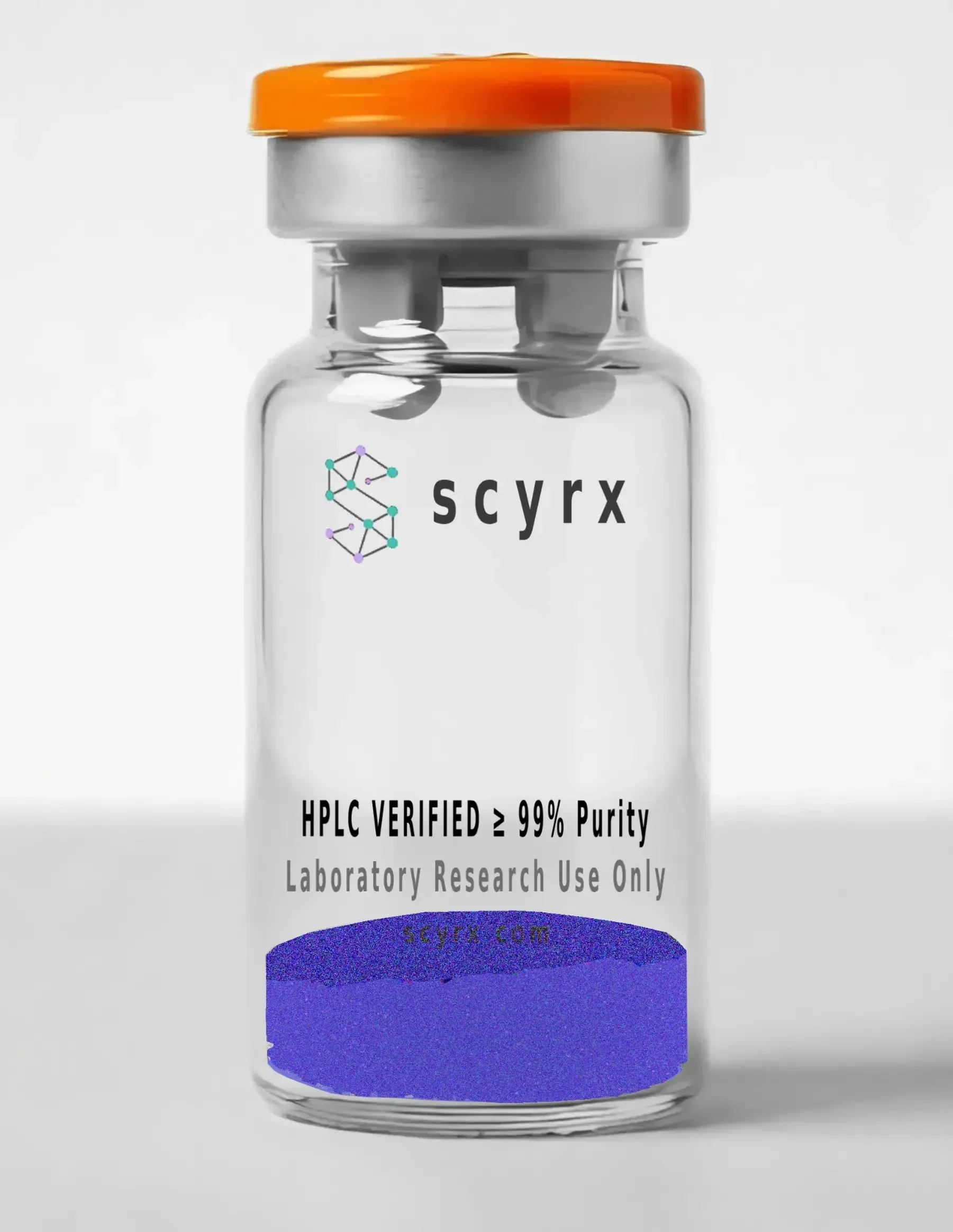
99% HPLC Purity · For Laboratory Research Use Only
Key Research Findings (At a Glance)
| Parameter | Summary |
|---|---|
| Peptide Structure | 3 amino acids (Gly-His-Lys copper-binding tripeptide) |
| Origin | Endogenous human plasma, saliva, and urine |
| Primary Mechanism | Collagen synthesis, extracellular matrix (ECM) remodeling, copper delivery |
| Key Research Areas | Dermal regeneration, wound healing, hair follicle stimulation, anti-aging |
| Distinguishing Feature | Resets gene expression to a younger, healthier state |
| Key Differentiator from BPC/TB-500 | Targets collagen/ECM remodeling; others target angiogenesis/cell migration |
| Common Dosage Range (Preclinical) | 50–200 mcg (subcutaneous); 1–5 mg (topical formulations) |
| Typical Administration | Subcutaneous injection or topical application |
| Intended Use | Laboratory research only – not for human or veterinary consumption |
Overview
GHK-Cu (Copper Tripeptide-1) is a naturally occurring, copper-binding tripeptide (Glycyl-L-Histidyl-L-Lysine) originally discovered in human plasma by Dr. Loren Pickart in 1973.
Frequently referenced in research communities simply as GHK-Cu or Copper Peptide, this compound is one of the most extensively studied molecules for tissue regeneration, extracellular matrix (ECM) remodeling, and anti-aging research. Investigators who buy research-grade GHK-Cu typically study it alongside BPC-157 when modeling combined dermal and connective-tissue repair.
Unlike many synthetic peptides, GHK-Cu is endogenous, meaning it is naturally produced by the human body. However, its concentration declines significantly with age. Research demonstrates that restoring GHK-Cu levels can reset the gene expression of cultured human cells to a younger, healthier state, promoting tissue repair and reducing inflammation.
GHK-Cu is highly versatile in research models. It is extensively studied via subcutaneous injection for systemic tissue repair, as well as in topical formulations for dermal regeneration, wound healing, and hair follicle stimulation.
Researchers seeking GHK-Cu for sale frequently pair it with TB-500 for comparative regenerative studies. Its unique ability to act as a copper chaperone—delivering copper precisely where it is needed for enzymatic reactions while preventing copper toxicity—makes it a foundational compound in regenerative research.
GHK-Cu is a 3-amino-acid copper-binding tripeptide (Gly-His-Lys) that acts as a biological signaling molecule. The copper ion (Cu²⁺) is coordinated by the histidine residue and is essential for its biological activity, enabling copper-dependent enzymatic reactions such as superoxide dismutase (SOD) and lysyl oxidase. Endogenous levels of GHK-Cu decline significantly with age, and research indicates that restoring these levels can reset gene expression to a younger, healthier state. This balance of structural simplicity, copper delivery, and pharmacological efficacy has established GHK-Cu as a foundational compound in dermal regeneration and ECM remodeling research.
Mechanism of Action: ECM Remodeling and Copper Delivery
Collagen and Elastin Synthesis
The primary mechanism of GHK-Cu involves the stimulation of fibroblasts to produce collagen types I and III, as well as elastin. Copper is an essential cofactor for the enzyme lysyl oxidase, which is required for the cross-linking of collagen and elastin fibers. By delivering copper directly to these enzymes, GHK-Cu significantly improves the structural integrity, elasticity, and strength of connective tissues.
Extracellular Matrix (ECM) Remodeling
GHK-Cu modulates the activity of matrix metalloproteinases (MMPs) and their inhibitors (TIMPs). This balanced regulation promotes the breakdown of damaged, irregular collagen (such as scar tissue) while stimulating the deposition of new, healthy extracellular matrix. This remodeling process is critical for functional tissue regeneration rather than simple scar-based repair.
Antioxidant and Anti-Inflammatory Effects
GHK-Cu exhibits potent antioxidant properties by activating copper-dependent superoxide dismutase (SOD), a primary enzyme that neutralizes harmful free radicals. Additionally, it suppresses the production of pro-inflammatory cytokines (like IL-6 and TNF-α), creating a favorable, low-inflammation environment that accelerates the healing cascade and protects tissues from oxidative stress.
Why Researchers Choose GHK-Cu Over Other Recovery Peptides
Versus BPC-157: While BPC-157 primarily drives angiogenesis (new blood vessel formation) and gut mucosal healing, GHK-Cu focuses on collagen synthesis and extracellular matrix remodeling. Researchers select GHK-Cu for dermal, skin, and structural ECM research, whereas BPC-157 is preferred for tendon/ligament and gastrointestinal applications.
Versus TB-500: TB-500 regulates actin cytoskeleton dynamics to promote cell migration and reduce fibrosis. GHK-Cu, by contrast, provides the actual building blocks (collagen/elastin) and enzymatic cofactors (copper) required to rebuild the tissue matrix. They are often studied together for complementary effects.
Versus Traditional Topicals/Growth Factors: Many topical growth factors degrade rapidly on the skin surface or fail to penetrate the dermis. GHK-Cu is uniquely stable, possesses excellent skin penetration capabilities, and has decades of robust clinical and preclinical data supporting its efficacy in tissue remodeling.
Primary Research Applications
- Dermal regeneration and skin remodeling studies
- Wound healing and surgical recovery modeling
- Hair follicle stimulation and androgenetic alopecia research
- Extracellular matrix (ECM) remodeling and scar tissue reduction
- Anti-aging and cellular senescence investigations
- Antioxidant and oxidative stress protection studies
- Comparative connective tissue repair studies (vs. BPC-157, TB-500)
GHK-Cu vs. BPC-157 vs. TB-500: Comparative Recovery and Healing Analysis
Researchers frequently compare these three peptides to understand distinct pathways through which they promote tissue repair, regeneration, and recovery.
| Feature | GHK-Cu | BPC-157 | TB-500 |
|---|---|---|---|
| Peptide Length | 3 amino acids | 15 amino acids | 7 amino acids (heptapeptide active fragment) |
| Origin | Endogenous human plasma/urine/saliva | Human gastric juice protein | Thymosin Beta-4 (endogenous) |
| Primary Mechanism | Collagen synthesis, ECM remodeling, copper delivery | VEGF upregulation, NO modulation, angiogenesis | G-actin sequestration, cell migration, anti-fibrotic |
| Primary Research Focus | Dermal regeneration, skin remodeling, anti-aging | Tendon/ligament repair, gut healing, angiogenesis | Soft tissue regeneration, cell migration, wound healing |
| Key Tissue Target | Skin, dermis, hair follicles, connective tissue | Connective tissue, gut mucosa, vasculature | Muscle, skin, cardiac tissue, CNS |
| Physiological Profile | Remodeling, collagen-stimulating, antioxidant | Angiogenic, cytoprotective, gastroprotective | Pro-migratory, anti-fibrotic, anti-inflammatory |
| Typical Research Dosing Scale | Micrograms to milligrams (mcg-mg) | Micrograms (mcg) | Micrograms (mcg) |
Note: While all three peptides promote tissue repair, GHK-Cu is distinguished by its collagen-stimulating and ECM remodeling profile, making it the primary choice for dermal and skin research. BPC-157 is preferred for angiogenesis and gut research, while TB-500 is selected for soft tissue regeneration and cell migration. Formulation ratios and purity metrics may vary by batch.
Product Specifications
Chemical Specifications (Acetate Salt)
| Specification | Value |
|---|---|
| Synonyms | GHK-Cu, Copper Tripeptide-1, Copper Peptide |
| Peptide Sequence | Gly-His-Lys-Cu·CH₃COOH |
| Peptide Length | 3 amino acids (Tripeptide) |
| Key Structural Notes | 3-amino-acid copper-binding tripeptide (Glycyl-L-Histidyl-L-Lysine); copper ion (Cu²⁺) is coordinated by the histidine residue |
| Structural Modification Overview | Copper Complex: The copper ion is essential for biological activity, enabling copper-dependent enzymatic reactions (e.g., superoxide dismutase, lysyl oxidase). Endogenous Origin: Naturally found in human plasma, saliva, and urine; levels decline significantly with age. |
| Base Chain | 3-amino-acid linear synthetic tripeptide (GHK) complexed with copper |
| Molecular Formula | C₁₄H₂₄CuN₆O₄ · C₂H₄O₂ |
| Molecular Weight | ~461.96 g/mol |
| SMILES | CC(=O)O.C1=C(N=CN1)C[C@@H](C(=O)N[C@@H](CCCCN)C(=O)[O-])[N-]C(=O)CN.[Cu+2] |
| SMILES Note | SMILES string may or may not include the acetate counterion. Full structural details are available via PubChem CID 154723978. |
| Purity | ≥99% by HPLC |
| Form | Lyophilized powder (Acetate Salt) |
Note: Formulation ratios and purity metrics may vary by batch. Always refer to the batch-specific Certificate of Analysis (COA) included with your order for exact composition and laboratory-verified specifications.
GHK-Cu: Acetate Salt vs. Free Base Comparison for Researchers
| Specification | Acetate Salt (SCYRX Supply) | Free Base (Reference Only) |
|---|---|---|
| Number of Amino Acids | 3 | 3 |
| Molecular Formula | C₁₄H₂₄CuN₆O₄ · C₂H₄O₂ | C₁₄H₂₄N₆O₄ |
| Molecular Weight | ~461.96 g/mol | ~340.38 g/mol |
| CAS Number | 300801-03-0 | 49557-75-7 |
| PubChem CID | 154723978 | 73587 |
| Form | Acetate Salt | Free Base |
Note: Molecular weights for acetate salt forms are approximate and may vary depending on the number of bound acetate molecules (x) in the salt complex. Values provided are based on the peptide core plus acetate counterions and should be used as a reference for research purposes only. Always refer to the batch-specific Certificate of Analysis (COA) for exact molecular weight verification.
Storage and Stability
| Condition | Recommendation |
|---|---|
| Long-term storage (lyophilized) | −20°C in tightly sealed container, protected from light and moisture – stable for up to 24 months |
| Shipping | Room temperature (15–25°C) for short periods (up to two weeks) – no significant degradation |
| After reconstitution | Refrigerate at 2–8°C; use within 28 days |
| Handling precautions | Avoid repeated freeze-thaw cycles and vigorous shaking to maintain peptide integrity |
Research Protocol Considerations
Note on Appearance: Upon reconstitution, GHK-Cu will naturally produce a clear, light blue to blue-green solution. This coloration is a normal, expected characteristic of the copper-peptide complex and is not an indicator of degradation or contamination.
Investigators studying comprehensive recovery protocols often research GHK-Cu alongside other tissue repair peptides. A common research design involves combining GHK-Cu (for collagen synthesis and ECM remodeling) with BPC-157 or TB-500 (for angiogenesis and cell migration) to study synergistic healing outcomes in complex injury models.
Research Dosing Considerations
GHK-Cu is evaluated in both microgram (mcg) quantities for subcutaneous injectable models and milligram (mg) quantities for topical formulation research. Upon reconstitution, GHK-Cu naturally produces a clear, light blue to blue-green solution. This coloration is a normal characteristic of the copper-peptide complex and is not an indicator of degradation or contamination.
GHK-Cu Research FAQ
Q: Is GHK-Cu approved for human use in research quantities?
A: Research-grade GHK-Cu is currently available for preclinical research only. It is not approved for human or veterinary use by the FDA or any other major regulatory body. It is supplied as a lyophilized powder for laboratory research purposes only. Researchers should consult all applicable institutional and regulatory guidelines before initiating study protocols.
Q: Why does reconstituted GHK-Cu have a blue or green tint?
A: This is a normal, expected characteristic of the product. The blue to blue-green coloration is the natural result of the copper ion (Cu²⁺) binding to the histidine residue of the GHK tripeptide. This color confirms the presence of the copper-peptide complex and is not an indicator of degradation, contamination, or poor quality.
Q: What is the primary mechanism of GHK-Cu in dermal research?
A: GHK-Cu primarily stimulates fibroblasts to produce collagen types I and III, as well as elastin. Copper is an essential cofactor for the enzyme lysyl oxidase, which is required for cross-linking collagen and elastin fibers. By delivering copper directly to these enzymes, GHK-Cu significantly improves the structural integrity, elasticity, and strength of connective tissues.
Q: Does GHK-Cu cause copper toxicity in research models?
A: No. GHK-Cu acts as a copper chaperone or buffer, not a toxic overload. It binds copper tightly and delivers it specifically to enzymes that require it (like lysyl oxidase), while simultaneously helping to chelate and remove excess, unbound copper from the body. Research indicates it helps normalize copper levels rather than causing toxicity.
Q: What is the difference between GHK-Cu, BPC-157, and TB-500?
A: These three peptides promote tissue repair through distinct mechanisms. GHK-Cu stimulates collagen synthesis and extracellular matrix remodeling. BPC-157 drives angiogenesis and gut healing. TB-500 regulates cell migration and reduces fibrosis. GHK-Cu is chosen for dermal and skin research, BPC-157 for vascularization, and TB-500 for soft tissue regeneration.
Q: Can GHK-Cu be used in topical research formulations?
A: Yes. GHK-Cu is extensively studied in topical applications. Due to its small molecular size (3 amino acids) and stability, it penetrates the skin barrier effectively. In research, it is frequently formulated into creams, serums, or hydrogels to study its effects on dermal regeneration, wound healing, and hair follicle stimulation.
Scientific References and Citations
- Pickart L, Margolina A. Regenerative and protective actions of the GHK-Cu peptide in the light of the new gene data. Int J Mol Sci. 2018;19(7):1968. doi:10.3390/ijms19071968
- Pickart L, Margolina A. GHK peptide as a natural modulator of multiple cellular pathways. BioMed Res Int. 2015;2015:648108. doi:10.1155/2015/648108
- Sidossis L, et al. The copper peptide GHK-Cu as a potential therapeutic for aging-related diseases. Front Endocrinol. 2023;14:1177667. doi:10.3389/fendo.2023.1177667
- Pickart L. The human tri-peptide GHK and tissue remodeling. J Biomater Sci Polym Ed. 2008;19(8):969-988. doi:10.1163/156856208784909445
- Pickart L, Vasquez-Soltero JM, Margolina A. GHK peptide as a natural modulator of multiple cellular pathways. Rejuvenation Res. 2012;15(3):322-330. doi:10.1089/rej.2012.1325
- Pickart L, Vasquez-Soltero JM, Margolina A. GHK copper peptide and the skin. J Drugs Dermatol. 2014;13(1):63-66.