Research Context
Our Sermorelin Acetate is a 29-amino-acid synthetic GHRH analog (GHRH 1-29) identical to the first 29 amino acids of native human GHRH, supplied as the acetate salt at >99% HPLC purity for pituitary and somatotropic-axis research. Frequently referred to in laboratory shorthand as Serm, GHRH 1-29, or Serma, this compound is studied for GHRH receptor agonism, endogenous GH stimulation, and comparative somatotropic-axis research in controlled laboratory investigations alongside complementary hormonal compounds for endocrine studies.
A 29-amino-acid fragment of GHRH researched across pituitary and somatotropic-axis studies.
Sermorelin Acetate (GHRH 1-29): Native Growth Hormone-Releasing Hormone Analog
Sermorelin Acetate (frequently referred to as Serm, GHRH 1-29, or Serma) is a synthetic 29-amino-acid peptide that is structurally identical to the first 29 amino acids of native, endogenous human Growth Hormone-Releasing Hormone (GHRH). It was the very first GHRH analog developed for clinical and research use, serving as the historical baseline for all subsequent somatotropic axis research. Because Serm is an exact replica of the native human sequence, it binds directly to GHRH receptors on pituitary somatotrophs to stimulate the synthesis and release of growth hormone (GH). Its unmodified N-terminus (Ala²) is susceptible to rapid degradation by the enzyme dipeptidyl peptidase-4 (DPP-4), resulting in an ultra-short biological half-life of approximately 10 to 20 minutes — a characteristic that strictly enforces a highly physiological, pulsatile GH release pattern without any risk of pituitary receptor desensitization.
Key Research Findings (At a Glance)
| Parameter | Summary |
|---|---|
| Peptide Structure | 29 amino acids (identical to native human GHRH 1-29) |
| Origin | Synthetic GHRH analog (acetate salt) |
| Primary Mechanism | GHRH receptor agonism (cAMP/PKA pathway) |
| Key Research Areas | Pituitary function, somatotropic axis, historical GH research |
| Distinguishing Feature | Unmodified native sequence; ultra-short half-life; strict physiological pulsatility |
| Key Differentiator from CJC-1295 No DAC | No DPP-4 resistance; ~10-20 min half-life vs. ~30 min |
| Typical Research Dosing Scale | 200–500 mcg per pulse (subcutaneous) |
| Common Combinations | Ipamorelin, GHRP-2, GHRP-6 |
| Intended Use | Laboratory research only – not for human or veterinary consumption |
Sermorelin Acetate Mechanism of Action: Native GHRH Receptor Agonism
Upon administration, Sermorelin binds to the GHRH receptors located on the anterior pituitary gland. This binding activates the adenylyl cyclase/cAMP (cyclic AMP) intracellular signaling pathway, which directly stimulates the transcription of the GH gene and the exocytosis of stored GH vesicles into the systemic circulation.
Native GHRH and Serma possess an alanine residue at the second position (Ala2) of their N-terminus, which is the exact cleavage site for the DPP-4 enzyme. DPP-4 rapidly cleaves this bond, rendering the peptide biologically inactive within minutes. This rapid clearance ensures that the pituitary is only exposed to short, discrete pulses of GHRH 1-29, perfectly mimicking the natural hypothalamic secretion pattern.
In the somatotropic axis, Sermorelin (a GHRH analog) and Growth Hormone Secretagogues (GHRPs like Ipamorelin) operate through distinct but complementary pathways. While Serm primarily increases the amplitude (magnitude) of the GH pulse via cAMP, GHRPs increase the frequency of the pulses via ghrelin receptor activation. This "pulse-burst" synergy is a primary focus in endocrine research, as combining the two yields significantly greater GH release than either compound alone.
Sermorelin vs. CJC-1295 No DAC vs. Tesamorelin: Comparative GHRH Analog Research Analysis
Researchers frequently compare these three Growth Hormone-Releasing Hormone analogs to understand the trade-offs between structural modifications, half-life, and specific research applications.
| Feature | Sermorelin (Serm) | CJC-1295 No DAC (MOD-GRF) | Tesamorelin |
|---|---|---|---|
| Peptide Length | 29 amino acids (Unmodified) | 29 amino acids (Modified) | 44 amino acids (Unmodified full-length) |
| Structural Modifications | None (identical to native human GHRH 1-29) | Substitutions to resist DPP-4 degradation | None (identical to native human GHRH 1-44) |
| Biological Half-Life | ~10 to 20 minutes | ~30 minutes | ~20 minutes |
| DPP-4 Resistance | None (rapidly degraded) | High (engineered for resistance) | Low (degraded similarly to Sermorelin) |
| Primary Mechanism | GHRH receptor agonism (cAMP/PKA pathway) | GHRH receptor agonism (cAMP/PKA pathway) | GHRH receptor agonism (cAMP/PKA pathway) |
| Key Research Advantage | Native sequence; historical baseline; ultra-strict pulsatility | DPP-4 resistance extends pulse duration slightly | FDA-approved (Egrifta); extensively studied for visceral adiposity |
| Primary Research Application | Historical GH axis studies, strict pulsatile modeling | Somatotropic axis, aging, combination protocols with GHRPs | HIV-associated lipodystrophy, visceral fat distribution |
| Typical Research Dosing Scale | Micrograms (200mcg - 500mcg per pulse) | Micrograms (100mcg - 300mcg per pulse) | Milligrams (1mg - 2mg daily) |
Note: While all three compounds stimulate GH release via GHRH receptor activation, Sermorelin is distinguished by its unmodified native sequence, which results in the shortest half-life and the strictest adherence to natural physiological pulsatility. Formulation ratios and purity metrics may vary by batch.
Sermorelin Acetate Chemical Specifications (Acetate Salt)
| Specification | Value |
|---|---|
| Synonyms | Sermorelin, Serm, GHRH 1-29, Serma, GRF 1-29, Growth Hormone-Releasing Hormone (1-29) |
| Peptide Sequence | H-Tyr-Ala-Asp-Ala-Ile-Phe-Thr-Asn-Ser-Tyr-Arg-Lys-Val-Leu-Gly-Gln-Leu-Ser-Ala-Arg-Lys-Leu-Leu-Gln-Asp-Ile-Met-Ser-Arg-NH2.CH3CO2H |
| Peptide Length | 29 amino acids |
| Key Structural Notes | 29-amino-acid synthetic GHRH analog; identical to the first 29 amino acids of native human GHRH |
| Structural Modification Overview | Native GHRH Analog: Synthetic peptide identical to the first 29 amino acids of endogenous human Growth Hormone-Releasing Hormone. GHRH Receptor Agonist: Binds to GHRH receptors on pituitary somatotrophs to stimulate GH synthesis and release via cAMP/PKA pathway. Rapid Clearance: Unmodified N-terminus (Ala²) is susceptible to DPP-4 degradation, resulting in ~10-20 minute half-life that enforces strict physiological pulsatility. Historical Baseline: First GHRH analog developed; serves as the 'gold standard' comparator for all subsequent somatotropic axis research. |
| Base Chain | 29-amino-acid linear synthetic polypeptide |
| Molecular Formula | C₁₄₉H₂₄₆N₄₄O₄₂S · xC₂H₄O₂ |
| Molecular Weight | 3417.9 g/mol |
| SMILES | CC[C@H](C)[C@@H](C(=O)N[C@@H](CC1=CC=CC=C1)C(=O)N[C@@H]([C@@H](C)O)C(=O)N[C@@H](CC(=O)N)C(=O)N[C@@H](CO)C(=O)N[C@@H](CC2=CC=C(C=C2)O)C(=O)N[C@@H](CCCNC(=N)N)C(=O)N[C@@H](CCCCN)C(=O)N[C@@H](C(C)C)C(=O)N[C@@H](CC(C)C)C(=O)NCC(=O)N[C@@H](CCC(=O)N)C(=O)N[C@@H](CC(C)C)C(=O)N[C@@H](CO)C(=O)N[C@@H](C)C(=O)N[C@@H](CCCNC(=N)N)C(=O)N[C@@H](CCCCN)C(=O)N[C@@H](CC(C)C)C(=O)N[C@@H](CC(C)C)C(=O)N[C@@H](CCC(=O)N)C(=O)N[C@@H](CC(=O)O)C(=O)N[C@@H]([C@@H](C)CC)C(=O)N[C@@H](CCSC)C(=O)N[C@@H](CO)C(=O)N[C@@H](CCCNC(=N)N)C(=O)N)NC(=O)[C@H](C)NC(=O)[C@H](CC(=O)O)NC(=O)[C@H](C)NC(=O)[C@H](CC3=CC=C(C=C3)O)N.CC(=O)O |
| SMILES Note | SMILES string may or may not include the acetate counterion. Full structural details are available via PubChem CID 16132412. |
| Purity | ≥99% by HPLC |
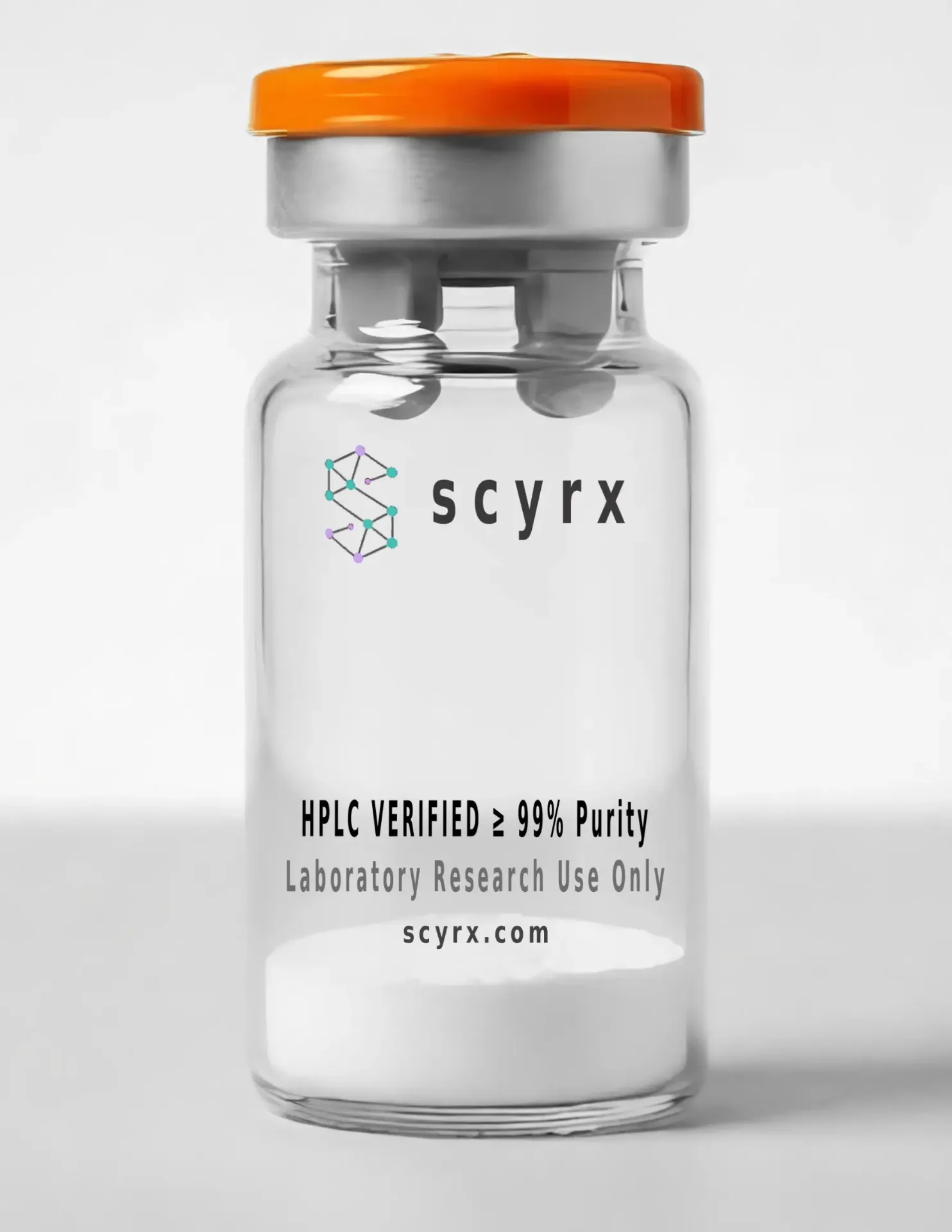
| Form | Lyophilized white powder |
Note: Formulation ratios and purity metrics may vary by batch. Always refer to the batch-specific Certificate of Analysis (COA) included with your order for exact composition and laboratory-verified specifications.
Sermorelin Acetate: Acetate Salt vs. Free Base Comparison for Researchers
For researchers reviewing the literature, Sermorelin Acetate is available as both a freebase and an acetate salt form. The acetate salt form is the standard research-grade version supplied by SCYRX, offering enhanced solubility and stability for laboratory applications. The freebase reference data is provided below for comparative literature review purposes only.
| Specification | Acetate Salt (SCYRX Supply) | Free Base (Reference Only) |
|---|---|---|
| Number of Amino Acids | 29 | 29 |
| Molecular Formula | C₁₄₉H₂₄₆N₄₄O₄₂S · xC₂H₄O₂ | C₁₄₉H₂₄₆N₄₄O₄₂S |
| Molecular Weight | 3417.9 g/mol | 3357.93 g/mol |
| CAS Number | 516482-86-3 | 86168-78-7 |
| PubChem CID | 16132412 | 16132413 |
| Form | Acetate Salt | Free Base |
Note: Molecular weights for acetate salt forms are approximate and may vary depending on the number of bound acetate molecules (x) in the salt complex. Values provided are based on the peptide core plus acetate counterions and should be used as a reference for research purposes only. Always refer to the batch-specific Certificate of Analysis (COA) for exact molecular weight verification.
Storage and Stability
Lyophilized Sermorelin Acetate should typically be stored at -20°C in a tightly sealed container, protected from light and moisture. Under these conditions, it generally remains stable for up to 24 months from the manufacture date.
Sermorelin Acetate can typically be shipped at room temperature for short periods (up to two weeks) without significant degradation, making it suitable for standard shipping methods.
Once reconstituted with bacteriostatic water, the solution should be refrigerated at 2-8°C and typically used within 28 days. Researchers should avoid repeated freeze-thaw cycles and vigorous shaking to maintain peptide integrity.
Research Dosing Considerations
In preclinical research models, Sermorelin Acetate is evaluated in microgram (mcg) quantities. Administration is most frequently via subcutaneous injection. Due to its short half-life compared to modified analogs, it is often studied in protocols requiring frequent dosing to maintain pulsatile GH release. Researchers typically use reconstitution volumes of 1–3 mL for precise measurement.
Sermorelin Acetate is typically reconstituted with bacteriostatic water. Because Serma is highly potent and evaluated in microgram (mcg) amounts per pulse (commonly 200mcg, 300mcg, or 500mcg protocols), researchers must use precise reconstitution volumes (e.g., 1mL to 3mL) and highly accurate measurement tools (such as insulin syringes) to ensure correct dosing.
In research models, GHRH 1-29 is typically administered via subcutaneous injection to mimic the natural hypothalamic pulse. Investigators studying comprehensive endocrine protocols frequently research Sermorelin alongside Growth Hormone Secretagogues (GHRPs) such as Ipamorelin, GHRP-2, or GHRP-6. This combination is studied for its synergistic "pulse-burst" effects, where the GHRH analog amplifies the magnitude of the GH pulse while the GHRP amplifies the frequency.
Sermorelin Acetate Research FAQ
Q: Is Sermorelin Acetate approved for human use or available for personal consumption?
A: No. Sermorelin Acetate sold by SCYRX is supplied strictly as a research-grade compound for in vitro and preclinical laboratory investigation. It is not intended for human consumption, therapeutic application, or any in vivo human use. All material is sold for laboratory research only.
Q: What is the primary mechanism of Sermorelin Acetate in pituitary research?
A: Sermorelin is a synthetic analog of the first 29 amino acids of endogenous Growth Hormone-Releasing Hormone (GHRH). It binds to GHRH receptors on the somatotroph cells of the anterior pituitary, stimulating the synthesis and release of growth hormone in a pulsatile manner that mimics natural physiology.
Q: How does Sermorelin differ from CJC-1295 (No DAC)?
A: While both are GHRH analogs, Sermorelin is the unmodified GRF (1-29) sequence, whereas CJC-1295 contains specific amino acid substitutions that protect it from enzymatic degradation. This gives CJC-1295 a longer half-life, while Sermorelin provides a more transient, naturalistic pulse of GH release.
Q: Why is Sermorelin frequently used as a baseline comparator in GH research?
A: As the original synthetic GHRH fragment, Sermorelin serves as the "gold standard" for comparing the efficacy of newer, modified analogs. Its well-documented pharmacokinetic profile makes it an essential control compound in studies evaluating novel secretagogues or GHRH derivatives.
Q: Does Sermorelin cause significant side effects in research models?
A: Research indicates Sermorelin is generally well-tolerated due to its structural identity with endogenous GHRH. The most commonly reported effects are mild injection site reactions and transient flushing. It does not typically elevate cortisol or prolactin levels significantly when used in standard research protocols.
Q: Can Sermorelin be stacked with Ipamorelin in research protocols?
A: Yes. Combining a GHRH analog (Sermorelin) with a ghrelin mimetic (Ipamorelin) is a widely studied strategy to achieve synergistic GH release. This combination targets two distinct pathways in the somatotropic axis, often resulting in greater GH amplitude than either compound used in isolation.
Related Products
Researchers studying Sermorelin Acetate frequently reference the following hormonal and performance compounds in companion protocols:
Scientific References and Citations
- Thorner MO, Perryman RL, Rogol AD, et al. Growth hormone-releasing hormone. N Engl J Med. 1992;326(7):455-462. doi:10.1056/NEJM199202133260706
- Boehm TM, Hunter WM, Greenwood FC, et al. Sermorelin: a review of its pharmacokinetic and pharmacodynamic properties. Clin Pharmacokinet. 1985;10(4):324-338. doi:10.2165/00003088-198510040-00003
- Grossman A, Savage MV, Lytras N, et al. Response to analogues of growth-hormone-releasing hormone in normal subjects, in growth hormone deficiency, and in acromegaly. Lancet. 1985;2(8459):835-840. doi:10.1016/s0140-6736(85)92666-5
- Veldhuis JD, Carlson ML, Johnson ML. The pituitary gland secretes in bursts: appraising the nature of glandular secretory bursts by simultaneous multiple-parameter deconvolution of serum hormone concentrations. Proc Natl Acad Sci U S A. 1987;84(21):7686-7690. doi:10.1073/pnas.84.21.7686
- Leal SC, Molina E, Argente JB, et al. Sermorelin: a review of its use in the diagnosis and treatment of growth hormone deficiency. Drugs Aging. 1999;14(4):297-311. doi:10.2165/00002512-199914040-00005
- Chapman IM, Hartman ML, Pezzoli SS, Thorner MO. Growth hormone (GH) secretion and GH-releasing peptide-6 are synergistic. J Clin Endocrinol Metab. 1993;76(6):1571-1576. doi:10.1210/jcem.76.6.8509865