Research Context
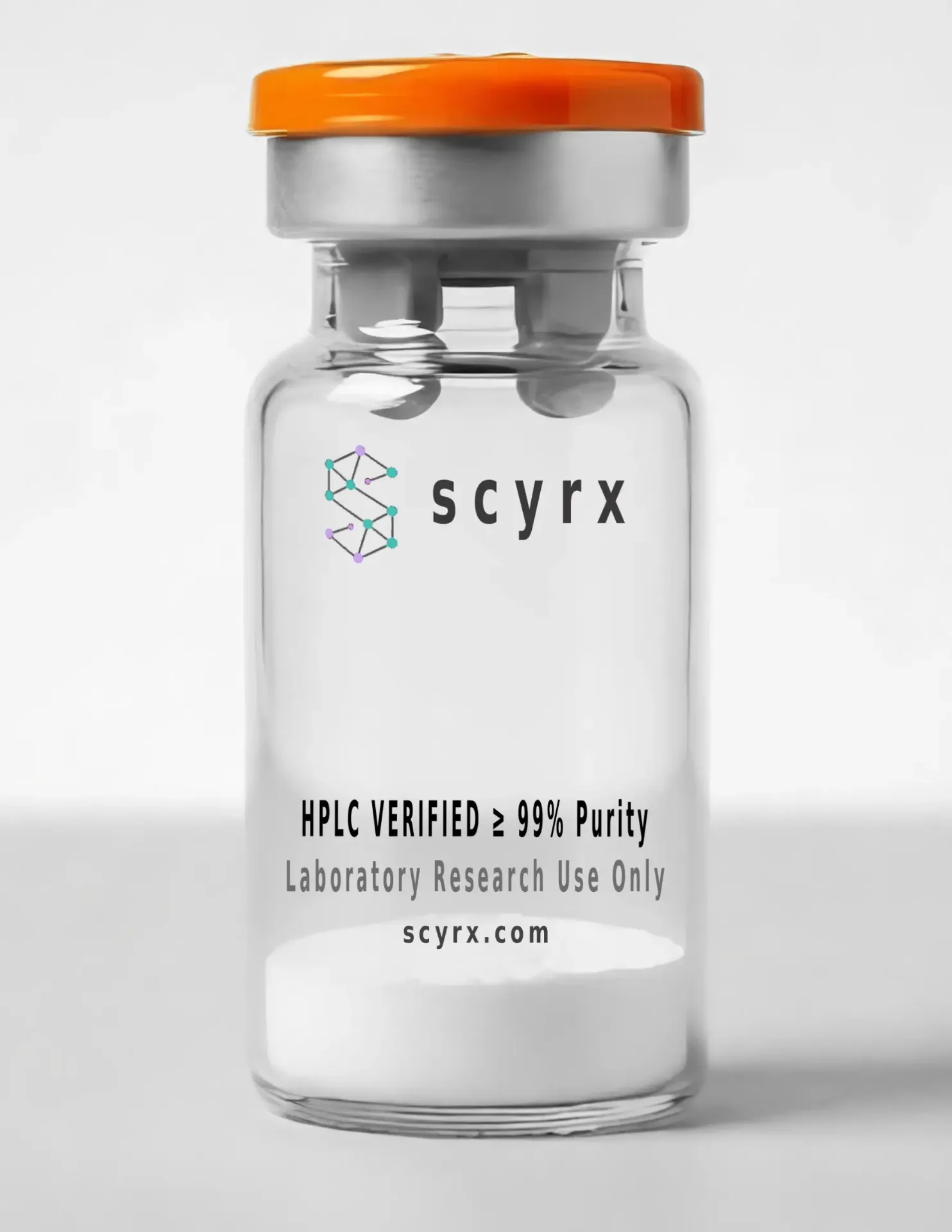
Our GHRP-2 is a 6-amino-acid synthetic hexapeptide (H-D-Ala-D-2-Nal-Ala-Trp-D-Phe-Lys-NH₂) engineered as a potent ghrelin receptor (GHSR-1a) agonist, supplied at >99% HPLC purity for GH-release and somatotropic-signaling research. Frequently referred to in laboratory shorthand as GHRP-2, GHRP2, or Pralmorelin, this compound is studied for endogenous GH release, IGF-1 stimulation, and appetite modulation in controlled laboratory investigations alongside complementary hormonal compounds for comparative endocrine research.
A ghrelin-mimetic peptide investigated for its potent influence on growth-hormone release.
GHRP-2: Mechanism of Action and Endocrine Research Applications
Our GHRP-2 is a 6-amino-acid synthetic hexapeptide (H-D-Ala-D-2-Nal-Ala-Trp-D-Phe-Lys-NH₂) engineered as a potent ghrelin receptor (GHSR-1a) agonist, supplied at >99% HPLC purity for GH-release and somatotropic-signaling research. Frequently referred to in laboratory shorthand as GHRP-2, GHRP2, or Pralmorelin, this compound is studied for endogenous GH release, IGF-1 stimulation, and appetite modulation in controlled laboratory investigations alongside complementary hormonal compounds for comparative endocrine research.
Overview
GHRP-2 (frequently referred to as GHRP2, Pralmorelin, or Growth Hormone Releasing Peptide-2) is a synthetic hexapeptide and a potent growth hormone secretagogue (GHS). It functions as a ghrelin receptor agonist, specifically binding to the growth hormone secretagogue receptor type 1a (GHS-R1a) in the pituitary gland and hypothalamus to stimulate the synthesis and release of endogenous growth hormone (GH). GHRP-2 occupies a unique position among the GHRP family — it is more potent at releasing GH than Ipamorelin, but less selective, meaning it can cause mild elevation of cortisol and prolactin levels compared to the "cleaner" profile of Ipamorelin. GHRP-2 is also structurally related to GHRP-6, but with modifications that significantly reduce its appetite-stimulating effects, making it a balanced choice for researchers who want potent GH release without the extreme hunger effects of GHRP-6.
Key Research Findings (At a Glance)
| Parameter | Summary |
|---|---|
| Peptide Structure | 6 amino acids (H-D-Ala-D-2-Nal-Ala-Trp-D-Phe-Lys-NH₂) |
| Origin | Synthetic ghrelin receptor agonist (GHSR-1a) |
| Primary Mechanism | GHSR-1a agonism, endogenous GH release, IGF-1 stimulation |
| Key Research Areas | Growth hormone deficiency, body composition, appetite signaling, metabolic research |
| Distinguishing Feature | High potency; balanced GH release with moderate selectivity |
| Key Differentiator from Ipamorelin | More potent GH release; less selective (mild cortisol/prolactin elevation) |
| Key Differentiator from GHRP-6 | More potent; significantly less appetite stimulation |
| Typical Research Dosing Scale | 100–300 mcg per administration (subcutaneous) |
| Common Combinations | CJC-1295 No DAC, Sermorelin, Tesamorelin |
| Intended Use | Laboratory research only – not for human or veterinary consumption |
GHRP-2 Mechanism of Action: Ghrelin Receptor Agonism and GH Potency
GHRP-2 binds to the growth hormone secretagogue receptor (GHS-R), also known as the ghrelin receptor, which is expressed in the pituitary gland and hypothalamus. This binding mimics the action of endogenous ghrelin, triggering a signaling cascade that stimulates the synthesis and release of growth hormone from somatotroph cells in the anterior pituitary. GHRP-2 has higher binding affinity and GH-releasing potency than Ipamorelin, but lower than GHRP-6.
Unlike the highly selective Ipamorelin, GHRP-2 demonstrates moderate selectivity. Research models show that GHRP2 can cause mild to moderate elevation of cortisol (a stress hormone) and prolactin, though significantly less than the non-selective GHRP-6. This moderate selectivity makes Growth Hormone Releasing Peptide-2 a balanced choice for researchers who want potent GH release without the extreme side effects of GHRP-6 or the lower potency of Ipamorelin.
While GHRP-6 is a potent ghrelin-mimetic that strongly stimulates hunger, GHRP-2 has been modified to reduce this effect. Research demonstrates that GHRP-2 can still cause mild appetite stimulation in some models, but it is significantly less pronounced than GHRP-6. This makes GHRP2 more suitable for body composition research where extreme hunger is undesirable.
GHRP-2 vs. Ipamorelin vs. GHRP-6: Comparative GHRP Research Analysis
Researchers frequently compare these three growth hormone releasing peptides to understand the trade-offs between GH release potency, selectivity, and side effect profiles.
| Feature | GHRP-2 | Ipamorelin (Ipa) | GHRP-6 |
|---|---|---|---|
| Peptide Type | Hexapeptide (6 amino acids) | Pentapeptide (5 amino acids) | Hexapeptide (6 amino acids) |
| Receptor Target | GHS-R1a (ghrelin receptor) | GHS-R1a (ghrelin receptor) | GHS-R1a (ghrelin receptor) |
| GH Release Potency | High | Moderate | Very High |
| Selectivity | Moderately selective (mild cortisol/prolactin elevation) | Highly selective (minimal cortisol/prolactin effects) | Non-selective (significant cortisol/prolactin elevation) |
| Appetite Stimulation | Mild | Minimal | Strong (potent ghrelin-mimetic) |
| Water Retention Risk | Moderate | Low | High |
| Primary Research Application | Balanced potent GH release, body composition studies | Clean GH elevation, aging research, combination protocols | Maximum GH release, appetite research |
| Typical Research Dosing Scale | Micrograms (100-300 mcg) | Micrograms (100-300 mcg) | Micrograms (100-300 mcg) |
| Common Combinations | CJC-1295 No DAC, Sermorelin | CJC-1295 No DAC, Sermorelin, Tesamorelin | CJC-1295 No DAC (less common due to side effects) |
Note: While all three peptides stimulate GH release through ghrelin receptor activation, GHRP-2 is distinguished by its balanced profile—more potent than Ipamorelin but more selective than GHRP-6. Researchers often combine GHRPs with GHRH analogs (such as CJC-1295 or Sermorelin) for synergistic effects. Formulation ratios and purity metrics may vary by batch.
GHRP-2 Chemical Specifications (Acetate Salt)
| Specification | Value |
|---|---|
| Synonyms | GHRP-2, GHRP2, Pralmorelin, Growth Hormone Releasing Peptide-2 |
| Peptide Sequence | H-D-Ala-D-2Nal-Ala-Trp-D-Phe-Lys-NH2.CH3CO2H |
| Peptide Length | 6 amino acids (Hexapeptide) |
| Key Structural Notes | 6-amino-acid synthetic hexapeptide; potent ghrelin receptor (GHSR-1a) agonist and growth hormone secretagogue |
| Structural Modification Overview | Ghrelin Receptor Agonist: Synthetic hexapeptide that binds to GHSR-1a (ghrelin receptor) in the pituitary and hypothalamus. Potent GH Release: Stimulates endogenous growth hormone secretion with high potency — more potent than Ipamorelin. Moderate Selectivity: May cause mild elevation of cortisol and prolactin; more selective than GHRP-6 but less selective than Ipamorelin. Diagnostic Utility: Used as a diagnostic agent for growth hormone deficiency assessment. Appetite Research: Modulates hunger signaling via ghrelin receptor activation. |
| Base Chain | 6-amino-acid linear synthetic hexapeptide |
| Molecular Formula | C₄₅H₅₅N₉O₆ · C₂H₄O₂ |
| Molecular Weight | 878.03 g/mol |
| SMILES | C[C@H](C(=O)N[C@H](CC1=CC2=CC=CC=C2C=C1)C(=O)N[C@@H](C)C(=O)N[C@@H](CC3=CNC4=CC=CC=C43)C(=O)N[C@H](CC5=CC=CC=C5)C(=O)N[C@@H](CCCCN)C(=O)N)N.CC(=O)O |
| SMILES Note | SMILES string may or may not include the acetate counterion. Full structural details are available via PubChem CID 91971813. |
| Purity | ≥99% by HPLC |
| Form | Lyophilized white powder |
Note: Formulation ratios and purity metrics may vary by batch. Always refer to the batch-specific Certificate of Analysis (COA) included with your order for exact composition and laboratory-verified specifications.
GHRP-2: Acetate Salt vs. Free Base Comparison for Researchers
For researchers reviewing the literature, GHRP-2 is available as both a freebase and an acetate salt form. The acetate salt form is the standard research-grade version supplied by SCYRX, offering enhanced solubility and stability for laboratory applications. The freebase reference data is provided below for comparative literature review purposes only.
| Specification | Acetate Salt (SCYRX Supply) | Free Base (Reference Only) |
|---|---|---|
| Number of Amino Acids | 6 | 6 |
| Molecular Formula | C₄₅H₅₅N₉O₆ · C₂H₄O₂ | C₄₅H₅₅N₉O₆ |
| Molecular Weight | 878.03 g/mol | 817.97 g/mol |
| CAS Number | 158861-67-7 | 158861-67-7 |
| PubChem CID | 91971813 | 6918245 |
| Form | Acetate Salt | Free Base |
Note: Molecular weights for acetate salt forms are approximate and may vary depending on the number of bound acetate molecules (x) in the salt complex. Values provided are based on the peptide core plus acetate counterions and should be used as a reference for research purposes only. Always refer to the batch-specific Certificate of Analysis (COA) for exact molecular weight verification.
Storage and Stability
Lyophilized GHRP-2 should typically be stored at -20°C in a tightly sealed container, protected from light and moisture. Under these conditions, it generally remains stable for up to 24 months from the manufacture date.
GHRP-2 can typically be shipped at room temperature for short periods (up to two weeks) without significant degradation, making it suitable for standard shipping methods.
Once reconstituted with bacteriostatic water, the solution should be refrigerated at 2-8°C and typically used within 28 days. Researchers should avoid repeated freeze-thaw cycles and vigorous shaking to maintain peptide integrity.
Research Dosing Considerations
In preclinical research models, GHRP-2 is evaluated in microgram (mcg) quantities. Administration is most frequently via subcutaneous injection. Due to its potent ghrelin-mimetic properties, it is often studied in protocols examining both growth hormone pulsatility and hunger signaling pathways. Researchers typically use reconstitution volumes of 1–3 mL for precise measurement.
GHRP-2 is typically reconstituted with bacteriostatic water. Because it is dosed in microgram amounts in research models (commonly 100mcg, 200mcg, or 300mcg protocols), researchers typically use reconstitution volumes of 1–3mL to allow for precise measurement with insulin syringes.
In research protocols, GHRP2 is often administered subcutaneously, frequently in combination with GHRH analogs such as CJC-1295 No DAC, Sermorelin, or Tesamorelin. The combination of a GHRP with a GHRH analog is studied for its ability to produce greater GH release than either compound alone, as they operate through different but complementary signaling pathways.
GHRP-2 Research FAQ
Q: Is GHRP-2 approved for human use or available for personal consumption?
A: No. GHRP-2 sold by SCYRX is supplied strictly as a research-grade compound for in vitro and preclinical laboratory investigation. It is not intended for human consumption, therapeutic application, or any in vivo human use. All material is sold for laboratory research only.
Q: What is the primary mechanism of GHRP-2 in endocrine research?
A: GHRP-2 is a synthetic hexapeptide that acts as a potent agonist of the growth hormone secretagogue receptor (GHS-R), also known as the ghrelin receptor. By binding to this receptor in the pituitary and hypothalamus, it stimulates a significant and rapid release of endogenous growth hormone.
Q: How does GHRP-2 differ from GHRP-6?
A: While both are ghrelin mimetics, GHRP-2 is generally considered more potent on a per-milligram basis for GH release. However, GHRP-6 is known for having a stronger effect on appetite stimulation (hunger signaling). GHRP-2 provides a "cleaner" profile for researchers focusing primarily on GH amplitude without extreme hunger effects.
Q: Why is GHRP-2 frequently compared to Ipamorelin?
A: GHRP-2 is a non-selective secretagogue that can elevate cortisol and prolactin levels alongside GH, whereas Ipamorelin is highly selective and does not significantly affect these other hormones. Researchers compare them to study the trade-offs between maximum GH potency (GHRP-2) and hormonal selectivity (Ipamorelin).
Q: Does GHRP-2 cause significant side effects in research models?
A: Research indicates that GHRP-2 can cause transient elevations in cortisol, prolactin, and aldosterone. It may also stimulate appetite and cause mild water retention. These effects are dose-dependent and are important variables monitored in comparative endocrine studies.
Q: Can GHRP-2 be stacked with CJC-1295 in research protocols?
A: Yes. Combining a GHRP (like GHRP-2) with a GHRH analog (like CJC-1295) is a common strategy to study synergistic GH release. This combination targets two different receptors in the somatotropic axis, often resulting in a much higher amplitude of GH pulses than either compound used alone.
Related Products
Researchers studying GHRP-2 frequently reference the following hormonal and performance compounds in companion protocols:
Scientific References and Citations
- Bowers CY. Growth hormone-releasing peptide (GHRP). Cell Mol Life Sci. 1997;53(7):511-519. doi:10.1007/s000180050046
- Bowers CY, Momany FA, Sethumadhavan R, et al. Structure-activity studies of a novel growth hormone-releasing peptide, GHRP-2. J Endocrinol Invest. 1993;16(5 Suppl 1):36-42.
- Arvat E, Di Vito L, Lanfranco F, et al. New insights into the endocrine activities of growth hormone-releasing peptides in humans. J Endocrinol Invest. 2000;23(6 Suppl):3-12.
- Hataya Y, Akamizu T, Takaya K, et al. A low dose of ghrelin stimulates growth hormone (GH) release synergistically with GH-releasing hormone in humans. J Clin Endocrinol Metab. 2001;86(9):4552. doi:10.1210/jcem.86.9.7856
- Papotti M, Ghigo MC, Catapano D, et al. Growth hormone-releasing peptide binding sites in the human hypothalamus and pituitary. J Clin Endocrinol Metab. 1999;84(8):2856-2863. doi:10.1210/jcem.84.8.5931
- Cheng K, Chan WW, Barretto B, et al. Demonstration and characterization of the specific binding of growth hormone-releasing peptides to rat anterior pituitary and hypothalamic membranes. Biochem Biophys Res Commun. 1989;160(1):625-631. doi:10.1016/0006-291x(89)92592-6